
Discover how war risk insurance protects businesses, shipping, and aviation during global conflicts. Learn coverage types, case studies, and future trends in managing geopolitical risks.
In today’s unpredictable geopolitical climate, businesses, shipping companies, and global investors face heightened exposure to war-related perils. Traditional insurance often excludes damages caused by armed conflicts, terrorism, civil unrest, and political violence, leaving organizations vulnerable to catastrophic financial losses. This is where war risk insurance comes into play.
Designed to address risks stemming from military conflicts, invasions, sabotage, and politically driven disruptions, war risk coverage has become an essential tool for companies operating across volatile regions. With rising global tensions, sanctions, and security challenges, the demand for comprehensive war risk protection is greater than ever.
This article provides a deep dive into war risk insurance, exploring its evolution, scope, mechanisms, and the critical role it plays in safeguarding global trade, aviation, energy, and corporate assets in times of geopolitical turmoil.
What Is War Risk Insurance?
War risk insurance is a specialized policy designed to cover losses caused directly or indirectly by acts of war, political violence, and related disruptions. Unlike general property or liability coverage—which typically excludes such risks—war risk insurance provides financial security when conflicts threaten assets, personnel, or operations.
Key perils typically covered include:
- War, invasion, and hostile acts by foreign powers
- Civil wars, rebellions, and insurrections
- Terrorism, sabotage, and political violence
- Seizure, confiscation, or nationalization of assets
- Maritime blockades, hijacking, and piracy in war zones
By transferring these risks to insurers, corporations can maintain operational continuity, financial stability, and investor confidence even in high-risk geopolitical landscapes.
Why War Risk Insurance Matters in Geopolitical Conflicts
- Global Trade Vulnerability
Shipping lanes and logistics hubs are often targeted during conflicts. War risk insurance ensures cargo and vessels remain protected. - Rising Political Instability
Regions such as the Middle East, Eastern Europe, and parts of Africa face frequent unrest, making risk transfer essential for multinationals. - Aviation Security Concerns
Airlines flying over or near conflict zones must secure specialized aviation war risk coverage for both aircraft and passengers. - Infrastructure Exposure
Energy pipelines, communication systems, and financial institutions are primary targets during armed conflicts. - Investor Confidence
War risk coverage reassures shareholders and financiers, reducing volatility in times of crisis.
Historical Evolution of War Risk Insurance
The concept dates back centuries, evolving with global conflicts:
- 17th Century Marine Insurance – Lloyd’s of London began underwriting maritime war risks to protect traders.
- World Wars – Coverage expanded to aviation, property, and broader commercial assets.
- Cold War Era – Political risk and war risk insurance became crucial for multinational corporations.
- Post-9/11 – Terrorism coverage was redefined, and aviation war risk policies surged in importance.
- 21st Century Conflicts – Cyber warfare, drone strikes, and hybrid wars have reshaped risk models.
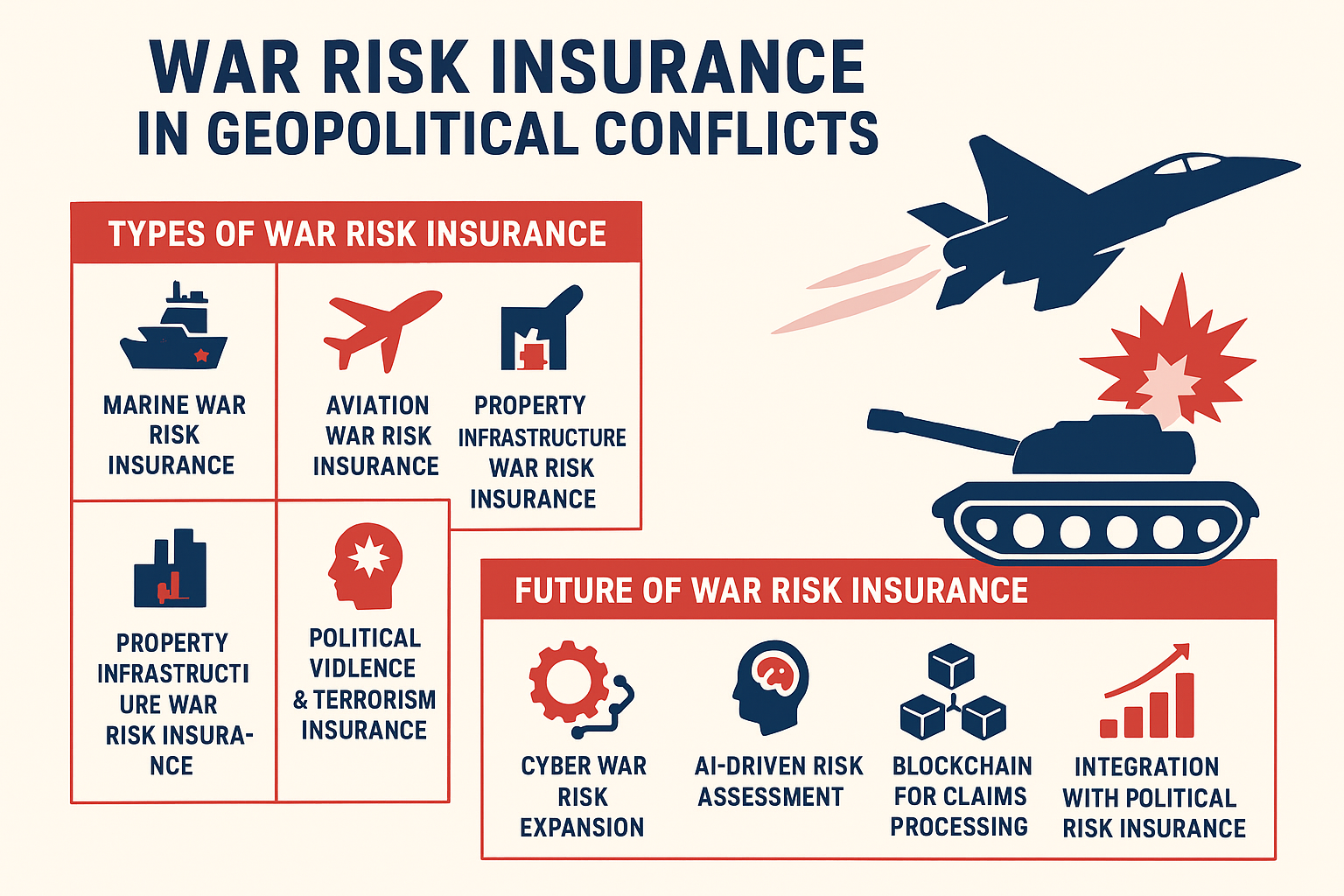
Types of War Risk Insurance
War risk insurance is offered in several specialized categories, depending on the sector:
1. Marine War Risk Insurance
- Protects ships, cargo, and crew operating in designated high-risk waters.
- Covers threats such as naval blockades, piracy, mines, and hostile acts.
2. Aviation War Risk Insurance
- Required for airlines flying into or over unstable regions.
- Covers aircraft damage, hijackings, and passenger liabilities.
3. Property & Infrastructure War Risk Insurance
- Covers physical damage to factories, offices, oil rigs, and utilities caused by war or terrorism.
4. Political Violence & Terrorism Insurance
- Provides protection against riots, sabotage, or politically motivated attacks outside full-scale war.
5. Specialty War Risk Covers
- Cyber war risk insurance for digital infrastructure.
- Energy-sector war risk protection for pipelines and offshore facilities.
Mechanisms of Coverage
1. Standard Exclusions in Traditional Insurance
Most property and liability policies exclude war-related perils, creating a need for standalone war risk insurance.
2. Specialist Underwriters
Global markets such as Lloyd’s of London and regional war risk pools underwrite these complex risks.
3. Premium Calculation
Premiums depend on:
- Geographic exposure (conflict-prone zones)
- Type of assets insured
- Real-time intelligence on geopolitical tensions
4. War Risk Surcharges
For shipping and aviation, insurers often impose additional surcharges for entering designated war-risk zones.
Geopolitical Hotspots and War Risk Demand
1. Middle East
Oil tankers in the Persian Gulf face high war risk premiums due to regional tensions.
2. Eastern Europe
The Russia-Ukraine conflict has redefined the importance of war risk insurance for global trade.
3. Africa
Civil unrest in countries like Sudan, Libya, and Nigeria drives demand for property and infrastructure coverage.
4. Asia-Pacific
Rising tensions in the South China Sea create vulnerabilities for shipping and aviation.
Case Studies in War Risk Insurance
Case Study 1: Tanker Attack in the Strait of Hormuz
An oil tanker insured under a marine war risk policy received compensation after being damaged by missile strikes.
Case Study 2: Aviation Losses in Conflict Zones
Airlines crossing Eastern Europe required aviation war risk extensions after airspace restrictions and aircraft seizures.
Case Study 3: Energy Infrastructure Disruption
A multinational oil corporation secured war risk coverage for offshore rigs in politically unstable regions, ensuring investor stability.
Challenges in War Risk Insurance
- Unpredictability – Geopolitical tensions can escalate without warning.
- Underwriting Complexity – Assessing real-time conflict risk is highly challenging.
- High Premium Volatility – Premiums fluctuate sharply based on global events.
- Limited Capacity – Only a few specialist insurers offer large-scale war risk policies.
- Exclusion of Nuclear Risks – Most policies exclude nuclear or chemical warfare.
The Future of War Risk Insurance
As geopolitical conflicts become more complex, the future of war risk insurance will involve:
- Cyber War Risk Expansion
Policies will increasingly cover state-sponsored cyberattacks. - AI-Driven Risk Assessment
Predictive analytics will help insurers calculate war exposure in real time. - Blockchain for Claims Processing
Smart contracts will speed up settlement of war-related claims. - Integration with Political Risk Insurance
Hybrid policies will merge war, terrorism, and political instability into a single framework. - Regional War Risk Pools
Governments and insurers may collaborate to create shared capacity during conflicts.
Strategic Importance for Corporates
Businesses operating globally must treat war risk insurance not as an optional add-on but as a core element of enterprise risk management. Companies should:
- Map geopolitical risk exposures
- Regularly update coverage in volatile regions
- Negotiate multi-jurisdictional policies with global insurers
- Integrate war risk policies with business continuity planning
Conclusion
War risk insurance is no longer a niche product but a strategic safeguard for global commerce, aviation, and critical infrastructure. In a world marked by geopolitical volatility, hybrid warfare, and evolving threats, organizations must secure robust coverage to remain resilient.
Whether protecting a shipping fleet in conflict waters, an airline flying near unstable zones, or multinational infrastructure in politically volatile regions, war risk insurance ensures continuity, investor confidence, and long-term stability.
The future of war risk insurance lies in advanced analytics, cyber risk integration, and flexible global frameworks that adapt to new forms of conflict. For businesses and investors, adopting a proactive approach to war risk coverage is not just smart risk management—it’s survival.