
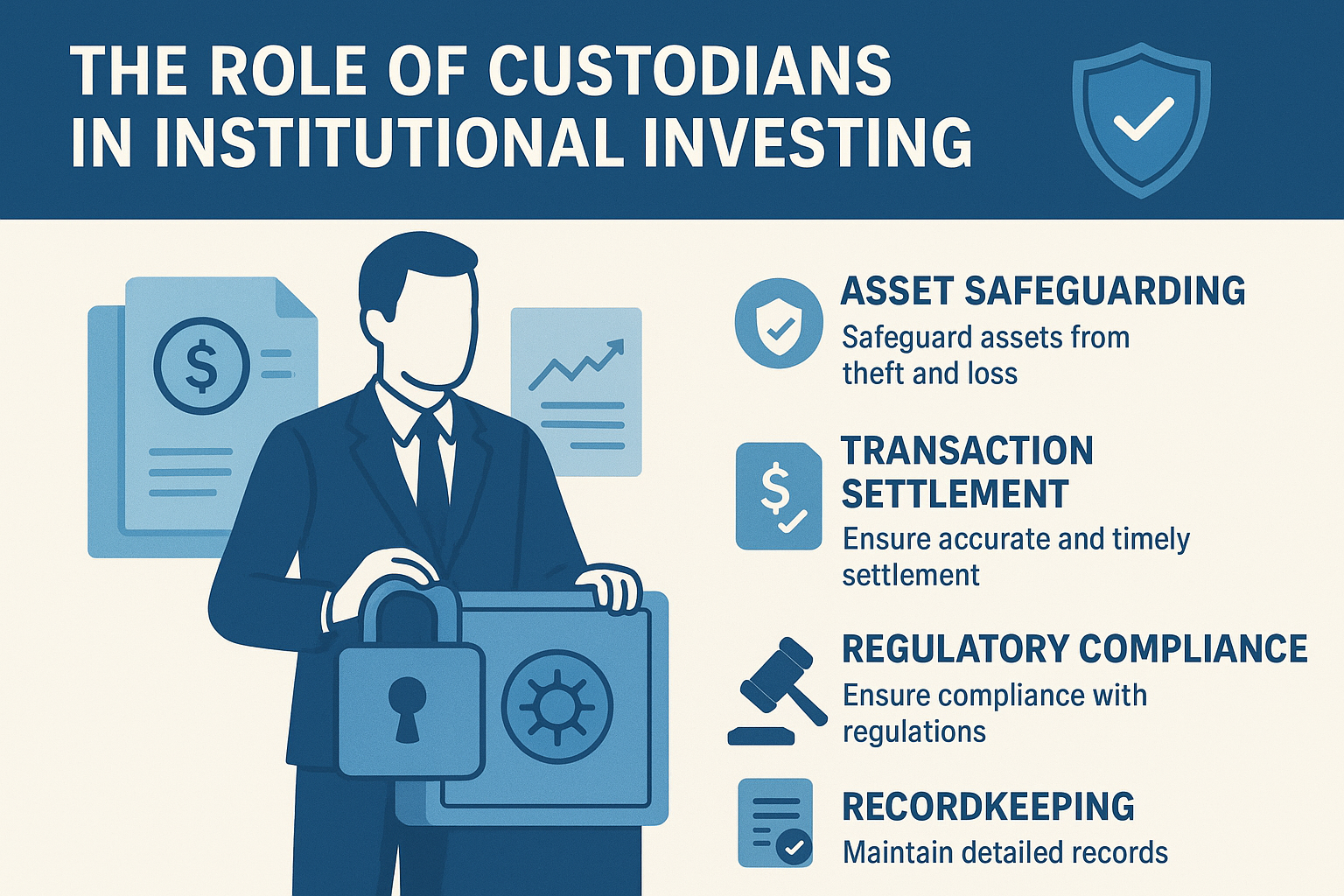
Beyond mere asset holders, modern custodians are strategic partners. Discover their critical role in safekeeping, settlement, income collection, and data analytics for pensions, endowments, and hedge funds.
The Unseen Engine of Global Finance
While asset managers and hedge fund traders capture headlines, the multi-trillion dollar engine of institutional investing runs on a less glamorous, yet indispensable, foundation: the custodian bank. For many, the role of a custodian is simplistically defined as “holding assets.” This perception is dangerously outdated. In today’s complex, globalized, and rapidly evolving financial markets, the custodian has evolved into a critical strategic partner, providing the operational integrity, risk mitigation, and technological infrastructure that enables institutional investors to focus on their core mission: generating alpha. This deep dive explores the multifaceted, dynamic, and increasingly sophisticated functions of these financial guardians, revealing why they are the bedrock upon which institutional portfolios are built.
Section 1: The Core Mandate – More Than Just a Vault
1.1 The Fundamental Principle: Safekeeping and Asset Protection
The primary and non-negotiable duty of a custodian is the secure holding of client assets. This provides a crucial layer of protection, segregating the investor’s holdings from the assets of the asset manager or the broker-dealer. In the event of a manager’s insolvency, this segregation ensures that client assets are not part of the bankruptcy estate and are safely returned.
- Beyond Physical Certificates: While the image of a physical vault persists, modern safekeeping is predominantly electronic. Custodians maintain electronic book entries in centralized securities depositories (e.g., the DTCC in the U.S.), acting as the legal record of ownership.
- The Duality of Protection: They protect against both institutional failure (as described above) and operational failure, through robust internal controls, cybersecurity measures, and insurance.
1.2 The Engine Room: Settlement and Clearing
Every trade initiated by a portfolio manager must be finalized. This post-trade process is where custodians provide immense value.
- The Settlement Cycle (T+1): The custodian ensures the efficient “delivery versus payment” (DvP) on the settlement date. They receive securities from the seller’s custodian and deliver cash from the buyer’s account, mitigating settlement risk.
- Managing Failed Trades: They proactively monitor and resolve any discrepancies that could cause a trade to fail, preventing potential losses and operational gridlock.
1.3 The Administrative Backbone: Asset Servicing
This is a vast suite of services that keeps an investment portfolio functioning smoothly.
- Corporate Actions Processing: Perhaps one of the most complex and risk-laden functions. This involves handling mandatory and voluntary events like mergers, spin-offs, tender offers, and proxy voting. A misstep here can lead to significant financial loss. The custodian informs the client, collects instructions, and executes them flawlessly.
- Income Collection (Dividends and Coupons): They ensure all interest and dividend payments are collected, reconciled, and credited to the client’s account in a timely manner, across global markets with different payment conventions.
Section 2: The Value-Added Evolution – From Guardian to Strategic Partner
The modern custodian does far more than just safeguard and administer. They have become enablers of efficiency and insight.
2.1 The Reporting Powerhouse: Data, Analytics, and Transparency
In an era driven by data, custodians are a primary source of truth.
- Consolidated Reporting: They provide a unified view of a global portfolio, aggregating holdings, transactions, and cash positions across multiple markets, asset classes, and currencies.
- Performance and Analytics: Advanced reporting tools offer performance attribution, risk analytics, and compliance monitoring, giving portfolio managers deeper insights into their strategies.
- ESG and Stewardship Reporting: As Environmental, Social, and Governance (ESG) investing grows, custodians are pivotal in collecting and reporting on proxy voting records, carbon footprint data, and other ESG metrics.
2.2 The Liquidity and Financing Hub
Custodians facilitate critical financing functions that optimize portfolio efficiency.
- Securities Lending: They operate massive securities lending programs, allowing institutional clients (e.g., pension funds) to lend out their dormant holdings to short-sellers or market makers, generating additional revenue (securities lending income) for the client.
- Cash Management: Offering sweep accounts and other short-term investment vehicles for uninvested cash, ensuring it remains productive rather than sitting idle.
- Collateral Management: In the world of derivatives and leveraged trading, they manage the complex movement and valuation of collateral assets, ensuring margin requirements are met.
2.3 The Global Gateway: Foreign Exchange and Cross-Border Expertise
For any investor looking beyond their domestic market, the custodian is the essential guide.
- Multi-Currency Settlement: They handle the intricate FX conversions needed to settle trades in dozens of currencies.
- Navigating Local Market Practices: Each country has its own settlement cycles, tax reclamation procedures, and regulatory hurdles. Global custodians leverage their local sub-custodian networks to provide seamless access and ensure compliance.
Section 3: The Indispensable Role in Alternative Investments
The explosion of alternatives (private equity, hedge funds, real estate) has forced custodians to innovate beyond traditional securities.
- The “Gateway” Problem: Custodians do not typically hold direct ownership of a private company or a physical building. Instead, they hold the feeder fund interests or partnership stakes.
- Providing Verification and Oversight: They act as an independent verifier of capital calls and distributions, providing transparency and fraud prevention in an otherwise opaque asset class. This oversight is a critical check and balance for institutional limited partners (LPs).
Section 4: Risk Mitigation – The Ultimate Value Proposition
The core reason institutions use custodians is risk management.
- Operational Risk Transfer: By outsourcing complex, non-core functions like settlement and corporate actions, the investment manager transfers significant operational risk to an entity built to manage it.
- Counterparty Risk Reduction: The DvP mechanism and segregated accounts drastically reduce the risk of loss from a broker’s failure.
- Fraud Prevention: Robust controls and independent reconciliation make it exceedingly difficult for internal or external bad actors to misappropriate assets.
Section 5: Selecting a Custodian – A Strategic Decision
Choosing a custodian is one of the most important decisions an institution makes. Key criteria include:
- Global Footprint and Network: Strength of the sub-custodian network in target markets.
- Technological Capability: The robustness, user-friendliness, and integration potential of their reporting and data platforms.
- Strength of Asset Servicing: Expertise in complex corporate actions and alternative assets.
- Financial Stability: The custodian itself must be a pillar of strength, with a strong credit rating.
- Fee Structure: Understanding the total cost of services, which can be complex and layered.
Conclusion: The Strategic Bedrock for the Future
The role of the custodian has transformed from a passive vault-keeper to an active, strategic partner integral to the safety, efficiency, and intelligence of institutional investing. As markets embrace digital assets, AI-driven analytics, and ever-greater complexity, the custodian’s role will only expand. They are the silent, reliable guardians whose operational excellence allows the financial world to innovate and grow with confidence. For any institution, a strong custodian isn’t just a service provider; it is the bedrock of a resilient and successful investment program.