
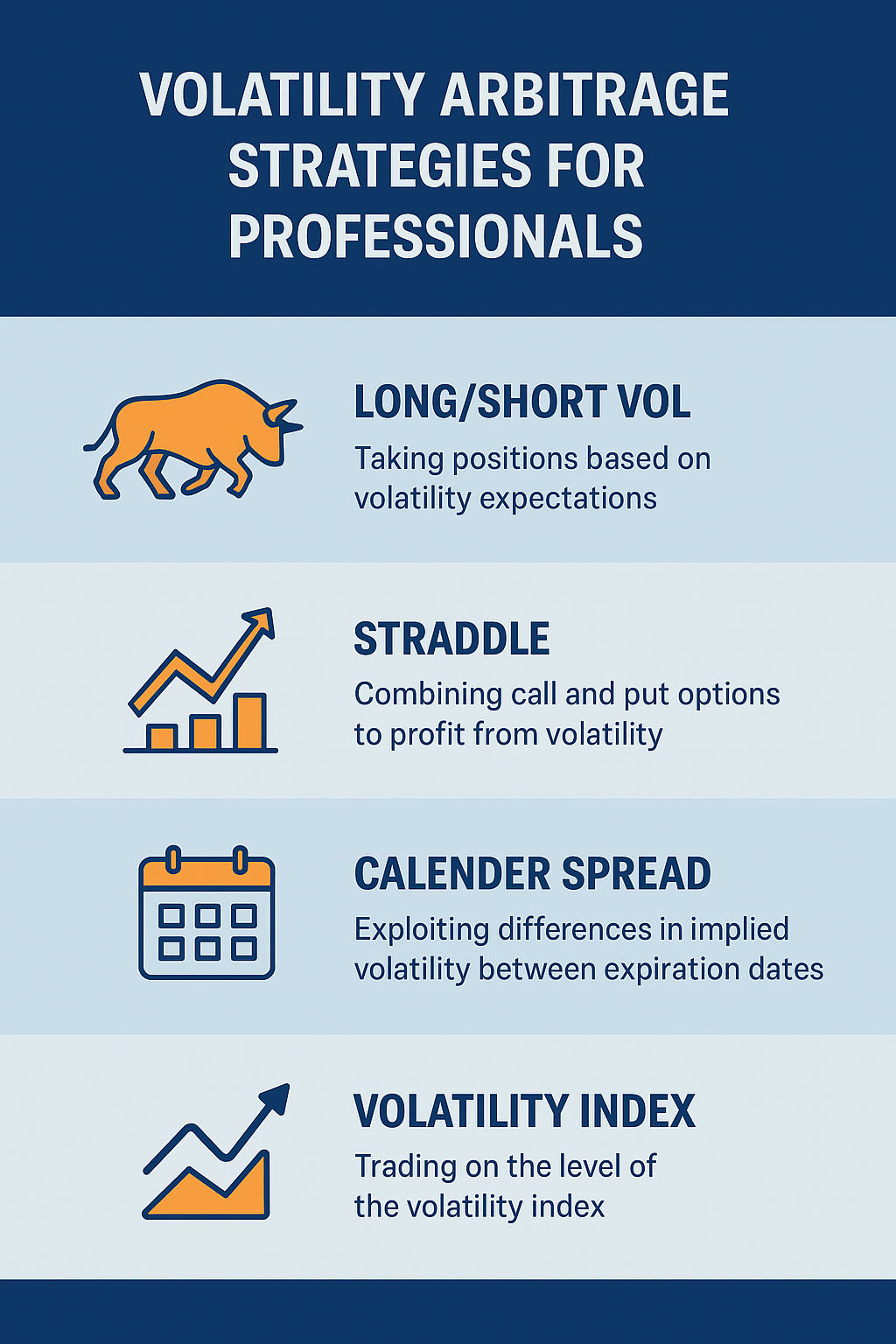
Tired of directional bets? Our professional guide unlocks the secrets of delta-neutral trading. Learn to systematically exploit the gap between implied and realized volatility using dispersion, skew arbitrage, and dynamic gamma scalping. Transform volatility from a risk into your primary profit center.
The Invisible Asset Class
For the quantitative analyst, the hedge fund manager, and the sophisticated institutional trader, volatility is not merely a measure of risk; it is a distinct and tradable asset class. While retail investors focus on directional price movements, professionals profit from the mispricing of uncertainty itself. This domain, known as volatility arbitrage, involves complex strategies designed to be market-neutral, aiming to generate consistent returns by exploiting the difference between an option’s implied volatility—the market’s forecast of future turbulence—and the subsequent realized volatility of the underlying asset. This exhaustive guide moves beyond theoretical definitions to provide a practical, in-depth exploration of the sophisticated strategies used by professionals to capture alpha in the options market.
Section 1: The Philosophical and Quantitative Foundation
1.1 The Core Tenet: Implied vs. Realized Volatility
At the heart of all volatility trading lies a simple premise: options are priced based on a forecast (implied volatility), but the underlying asset experiences a reality (realized volatility). The arbitrageur makes a calculated bet that these two will converge, or that one is fundamentally mispriced relative to the other.
- Implied Volatility (IV): The market’s expectation of future price swings, extracted from option prices using models like Black-Scholes. It is often called the “option’s price.”
- Realized Volatility (RV): The actual, historical standard deviation of the underlying asset’s returns over a specific period. It is what actually happened.
1.2 The Crucial Role of the Options Pricing Model
Identifying mispricing requires a robust model. While Black-Scholes is the foundational framework, professionals are acutely aware of its limitations (e.g., constant volatility assumption). They often use more nuanced models like stochastic volatility models (Heston) or jump-diffusion models to gain a more accurate edge in valuing complex positions.
1.3 The Trader’s Compass: The Greeks
To navigate this landscape, traders must achieve a state of delta-neutrality, insulating their portfolio from small directional moves in the underlying asset. However, their P&L is then driven by other Greeks:
- Vega (ν): Sensitivity to changes in implied volatility. Long vega positions profit from rising IV.
- Gamma (Γ): Sensitivity of the portfolio’s delta to moves in the underlying asset. It represents the “convexity” of the position.
- Theta (Θ): The time decay of the option’s value. It is the daily cost of holding a long options position.
Section 2: The Professional’s Arsenal: Core Volatility Arbitrage Strategies
2.1 The Long Volatility Play: The Delta-Neutral Straddle/Strangle
This is the classic bet on a mispricing in implied volatility.
- The Setup: Simultaneously buying a call and a put at the same strike (straddle) or nearby strikes (strangle) on the same underlying with the same expiration. The position is then adjusted to be delta-neutral.
- The Trade Thesis: The trader believes the current implied volatility is too low relative to the future realized volatility that will occur. They are long vega and long gamma.
- The Profit & Loss Driver: The position profits if the underlying asset moves significantly (high realized volatility) or if implied volatility increases across the board. The primary risk is theta decay—if the market remains stagnant, the position bleeds value daily.
2.2 The Short Volatility Harvest: Selling Overpriced Uncertainty
The mirror image of the long volatility play, this strategy is for when IV is perceived as excessively high.
- The Setup: Selling a delta-neutral straddle or strangle. The trader collects the premium upfront.
- The Trade Thesis: The trader believes the market is overestimating future turbulence. The implied volatility is expected to be higher than the realized volatility.
- The Profit & Loss Driver: The position profits from theta decay (time passing) and from vega decreasing (implied volatility collapsing). The risk is unlimited: a large, unexpected move in the underlying asset can lead to catastrophic losses. This necessitates rigorous risk management and often involves buying far out-of-the-money options as “tail risk” insurance.
2.3 Dispersion Trading: A Relative Value Masterpiece
This is a more advanced, multi-underlying strategy that exploits the difference between the index’s implied volatility and the implied volatility of its components.
- The Setup:
- Short Index Variance: Sell options on a market index (e.g., SPX), which typically trades at a volatility premium due to demand for portfolio protection.
- Long Single-Stock Variance: Buy options on a basket of the constituent stocks of that index.
- The Trade Thesis: The trader bets that the average correlation between the index components will be lower than what is implied by the index options’ price. In essence, they are betting that the index will be quieter than the sum of its parts.
- The P&L Driver: The trade profits if the individual stocks are more volatile than the index as a whole. It is a pure play on correlation. If correlations are high (a “risk-on” or “risk-off” market), the trade will suffer.
2.4 Volatility Skew Arbitrage: Exploiting Asymmetry in Fear
The volatility smile or skew describes the phenomenon where out-of-the-money puts often have higher implied volatility than at-the-money or out-of-the-money calls. Skew trading aims to profit from perceived mispricings in this structure.
- The Setup: A Risk Reversal or Vertical Spread.
- If a trader believes the skew is too steep (OTM puts are too expensive), they might sell an OTM put and use the premium to buy an OTM call—a strategy known as a “skew flattening” trade.
- Conversely, if they fear a crash and believe the skew is too flat, they might execute a “skew steepening” trade.
- The Trade Thesis: A view on the relative pricing of downside protection vs. upside speculation, often independent of the overall level of volatility.
2.5 Gamma Scalping: The Dynamic Hedger’s Art
For a trader holding a long gamma position (like a long straddle), gamma scalping is the active management process that monetizes volatility.
- The Mechanism: When the underlying asset moves, the portfolio’s delta changes due to gamma. A long gamma position becomes long delta as the price rises and short delta as it falls. The trader “scalps” by selling into rallies and buying into dips to re-establish delta neutrality.
- The P&L Driver: The profit comes from these dynamic hedges. The larger and more frequent the price oscillations (i.e., the higher the realized volatility), the more money is made from scalping, ideally exceeding the theta decay from the long options.
Section 3: The Execution and Risk Management Framework
3.1 The Devil in the Details: Transaction Costs and Liquidity
For professional strategies, bid-ask spreads, commission fees, and market impact are not afterthoughts; they are primary determinants of viability. A theoretically profitable strategy can be rendered useless by high transaction costs. Trading in liquid underlying assets and option contracts is paramount.
3.2 Advanced Hedging Techniques
True professionals don’t just set and forget delta neutrality. They engage in:
- Dynamic Delta Hedging: Continuously adjusting the hedge as the underlying moves.
- Vega Hedging: Using other options or volatility products (like VIX futures) to neutralize exposure to changes in the overall volatility surface.
- Multi-Asset Correlation Hedging: Managing the correlation risk inherent in strategies like dispersion trading.
3.3 The Quantitative Edge: Model Risk and Backtesting
A model is only as good as its assumptions. Professionals must constantly be aware of model risk—the risk that their pricing model is wrong. This is mitigated by rigorous backtesting against historical data and stress-testing under various market regimes (e.g., 2008 Financial Crisis, 2020 COVID-19 crash).
Section 4: The Evolving Landscape: ETFs, Variance Swaps, and Automation
4.1 Trading Volatility Directly: VIX Futures and ETFs
The introduction of VIX futures and products like the VXX ETF provided a direct, albeit complex, way to trade the CBOE Volatility Index. While not pure arbitrage, these instruments are used in sophisticated relative value trades against single-stock or index options.
4.2 The OTC Powerhouse: Variance Swaps
These over-the-counter instruments allow professionals to trade pure realized variance against implied variance without the complexities of managing an options book. They are a cleaner, more direct way to express a view on volatility, though they carry their own risks (e.g., jump risk).
4.3 The Rise of the Machines: Algorithmic Volatility Trading
The most cutting-edge arena is dominated by algorithmic systems that automatically price options, identify fleeting mispricings across multiple strikes and expirations, and execute complex hedges in milliseconds.
Conclusion: The Discipline of Trading Uncertainty
Volatility arbitrage is not a guaranteed path to riches; it is a discipline of quantitative rigor, relentless risk management, and psychological fortitude. The “arbitrage” is rarely risk-free; it is about identifying and pricing risk better than the market. For the professional who masters the interplay of the Greeks, understands the nuances of the volatility surface, and maintains impeccable discipline, it offers a powerful means to generate non-directional alpha, turning market uncertainty into a strategic advantage.