
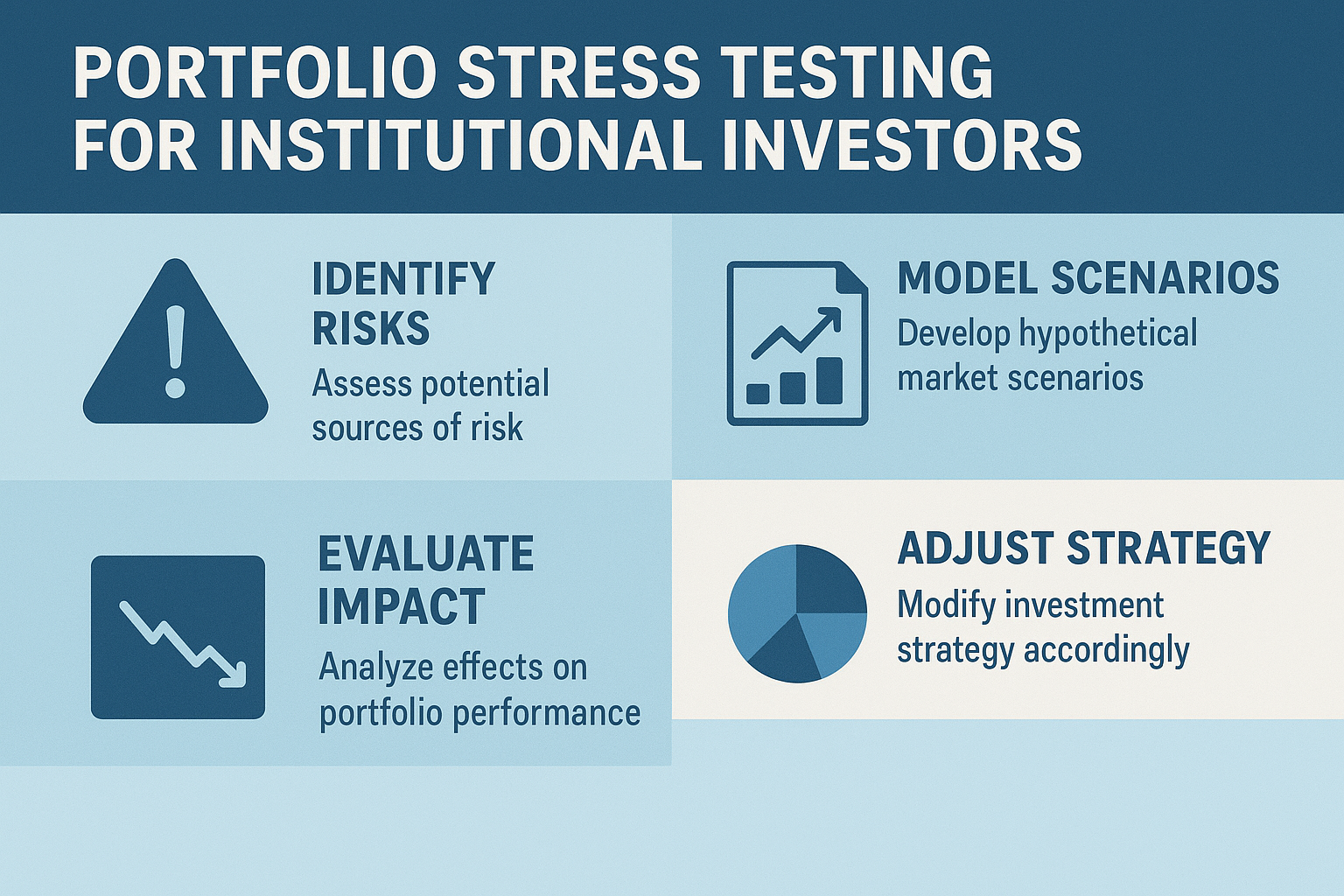
Move beyond basic risk metrics. Our guide to portfolio stress testing explores scenario design, liquidity shocks, correlation breakdowns, and regulatory requirements for pensions, endowments, and asset managers.
The Fiduciary Fire Drill
The years 2008, 2020, and 2022 delivered a powerful lesson to institutional investors: standard risk models fail when they are needed most. Value at Risk (VaR) and other backward-looking metrics offer a false sense of security in calm markets and shatter during genuine crises. For fiduciaries overseeing pension funds, endowments, and insurance assets, the question is no longer if a crisis will occur, but how resilient their portfolio will be when it does. This is the domain of advanced portfolio stress testing—the systematic “fire drill” that exposes hidden vulnerabilities, tests strategic assumptions, and transforms risk management from a compliance exercise into a core strategic advantage. This definitive guide provides a comprehensive framework for designing, implementing, and acting upon sophisticated stress tests that protect institutional capital.
Section 1: The “Why”: Moving Beyond Traditional Risk Metrics
1.1 The Failure of VaR in Tail Events
Value at Risk, while useful for measuring everyday market risk, has critical flaws:
- It Ignores Tail Risk: VaR tells you the minimum loss you can expect on a normal day (e.g., 95% confidence), but it says nothing about the catastrophic losses that can occur in the remaining 5% of events.
- Reliance on Normal Distributions: Financial markets are prone to fat tails and extreme moves that a normal distribution cannot capture.
- Backward-Looking: It’s based on recent historical data, which may have no bearing on the next crisis.
1.2 The Strategic Imperative of Stress Testing
Stress testing fills this void by asking “what if” questions that VaR cannot answer. Its primary objectives are:
- Capital Preservation: To understand the maximum potential loss in a crisis and ensure the institution can survive it.
- Informed Decision-Making: To provide a factual basis for strategic asset allocation, hedging, and liquidity management decisions.
- Regulatory Compliance & Communication: To meet regulatory requirements (e.g., Solvency II, Dodd-Frank) and effectively communicate risk to trustees and stakeholders.
Section 2: The Stress Testing Toolkit: A Spectrum of Methodologies
2.1 Sensitivity Analysis (“The Single Shock”)
The simplest form of stress testing, which shocks a single risk factor.
- Example: “What if interest rates rise by 200 basis points instantly?” or “What if the S&P 500 drops 20%?”
- Usefulness: Isolates the portfolio’s exposure to a specific variable. Limited because it ignores the correlation between assets during a real crisis.
2.2 Scenario Analysis (“The Narrative-Driven Crisis”)
This is the core of a robust framework. It involves constructing a coherent, narrative-based event and shocking all relevant risk factors simultaneously.
- Historical Scenarios: Re-running a past crisis (e.g., the 2008 Global Financial Crisis, the 2020 COVID-19 crash) on the current portfolio. The key question: “Would our portfolio today have performed better or worse?”
- Hypothetical Scenarios: Designing forward-looking crises that have not yet occurred but are plausible.
- Examples: A hard landing in China, a modern-day oil crisis, a systemic cyber-attack on financial infrastructure, a sudden inflation resurgence.
2.3 Reverse Stress Testing (“Finding the Breaking Point”)
A powerful but underutilized technique. Instead of asking “what is the loss in a given scenario?”, reverse stress testing asks: “what scenario would cause our portfolio to fail?”
- Objective: To identify the specific conditions that would lead to:
- A 40% drop in funded status for a pension.
- A violation of regulatory capital requirements for an insurer.
- A breach of covenant with lenders.
- Output: This reveals the portfolio’s Achilles’ heel, forcing a conversation about mitigating that specific existential risk.
Section 3: The Anatomy of a Modern Stress Scenario
A credible scenario must go beyond equity market declines.
3.1 The Multi-Asset Shock
A comprehensive scenario will specify shocks for:
- Equities: Differentiated shocks for regions, sectors, and market caps (e.g., Emerging Markets down 35%, Tech down 40%, Small Caps down 45%).
- Rates & Credit: A non-parallel shift in the yield curve (e.g., short rates up 150 bps, long rates up 50 bps), with credit spreads widening significantly (High-Yield spreads +600 bps, Investment Grade +250 bps).
- Alternatives: Estimating the impact on illiquid assets (Private Equity, Real Estate, Venture Capital) is challenging but critical. This often involves using public market proxies or applying liquidity haircuts.
- Currency: Sharp moves in FX rates, particularly for portfolios with unhedged international exposure.
3.2 The Liquidity and Funding Shock
This is often the killer in a crisis. The scenario must model:
- Market Liquidity Evaporation: Bid-ask spreads widening 5-10x, making it costly or impossible to exit positions at quoted prices.
- Funding Liquidity Pressure: Investor redemptions for funds, collateral calls on derivatives, and the revocation of credit lines by prime brokers.
3.3 The Correlation Breakdown
In a true crisis, the diversification benefits of a multi-asset portfolio can vanish as correlations converge to 1.0. A robust test must assume that previously uncorrelated assets fall together.
Section 4: The Implementation Framework: From Design to Action
4.1 Step 1: Governance and Scenario Selection
A cross-functional risk committee should approve the scenarios, ensuring they are severe, plausible, and relevant to the portfolio’s strategy.
4.2 Step 2: Data and Model Integration
This is the greatest technical challenge. It requires:
- Position-Level Data: Aggregating holdings from all custodians and managers.
- Liquidity Data: Incorporating position-level liquidity scores or estimated liquidation horizons.
- Factor Exposure Mapping: Understanding the portfolio’s underlying factor exposures (e.g., value, momentum, duration, credit) to model shocks more accurately.
4.3 Step 3: Execution and Reporting
The output is not a single number, but a comprehensive report detailing:
- Total Portfolio Loss: In absolute terms and as a percentage.
- Contributors to Loss: Which asset classes, strategies, or managers were the biggest detractors?
- Liquidity Analysis: How much cash could be raised in 1 day, 1 week, 1 month without fire-sale discounts?
- Impact on Key Metrics: Change in Funding Ratio, Sharpe ratio, and regulatory capital ratios.
4.4 Step 4: The Most Critical Step – Management Actions
The test is useless if it doesn’t lead to action. The report must answer:
- Mitigation: Can we hedge the identified risks? Should we reduce exposure to the most vulnerable assets?
- Contingency Planning: Do we have a pre-approved playbook for a liquidity crisis? What is the liquidation hierarchy?
- Strategic Review: Does this test challenge our long-term strategic asset allocation? Do we need a larger liquidity cushion?
Section 5: Advanced Topics and Emerging Risks
5.1 Climate Risk Stress Testing
A rapidly growing requirement, involving two key scenarios:
- Physical Risk: The financial impact of more frequent and severe climate events (hurricanes, floods, wildfires) on real asset holdings and supply chains.
- Transition Risk: The impact of a rapid shift to a low-carbon economy (e.g., via carbon taxes) on “stranded assets” like fossil fuel reserves and related equities.
5.2 Integrating Counterparty and Concentration Risk
Testing the impact of the default of a major counterparty (e.g., a swap dealer) or the collapse of a large position that the portfolio is concentrated in.
5.3 Leverage and Derivative Stress Testing
Modeling the “collateral spiral”—where falling asset values trigger margin calls, forcing asset sales, which further depress prices and trigger more margin calls.
Conclusion: Building a Resilient Institution
Advanced portfolio stress testing is not about predicting the future; it is about preparing for multiple possible futures. It is a discipline that fosters a culture of risk-awareness and strategic clarity. For institutional investors, the ability to look into the abyss during calm markets and emerge with a stronger, more resilient portfolio is the ultimate expression of fiduciary duty. In a world of increasing complexity and interconnected risks, a robust stress testing framework is not a luxury—it is the bedrock of sustainable long-term capital stewardship.