
Discover how machine learning is revolutionizing insurance pricing by enhancing risk assessment, predicting claims, and personalizing premiums. Learn the benefits, challenges, and future of AI in insurance.
Why Machine Learning Is Changing Insurance Forever
The insurance industry has always been data-driven. From actuarial science to statistical risk modeling, insurers have relied on numbers to calculate premiums and forecast losses. However, the digital age has created an explosion of data—ranging from telematics and IoT devices to social media and transaction history. This massive volume of structured and unstructured data has made traditional statistical methods insufficient. Enter machine learning (ML), a branch of artificial intelligence that uses algorithms to identify patterns, predict outcomes, and continuously learn from data.
Machine learning is no longer a futuristic idea—it is actively transforming how insurers set prices, assess risks, and personalize coverage. In this article, we’ll explore the role of machine learning in insurance pricing, highlight real-world use cases, and discuss the ethical and regulatory challenges that accompany its adoption.
Understanding the Basics of Insurance Pricing
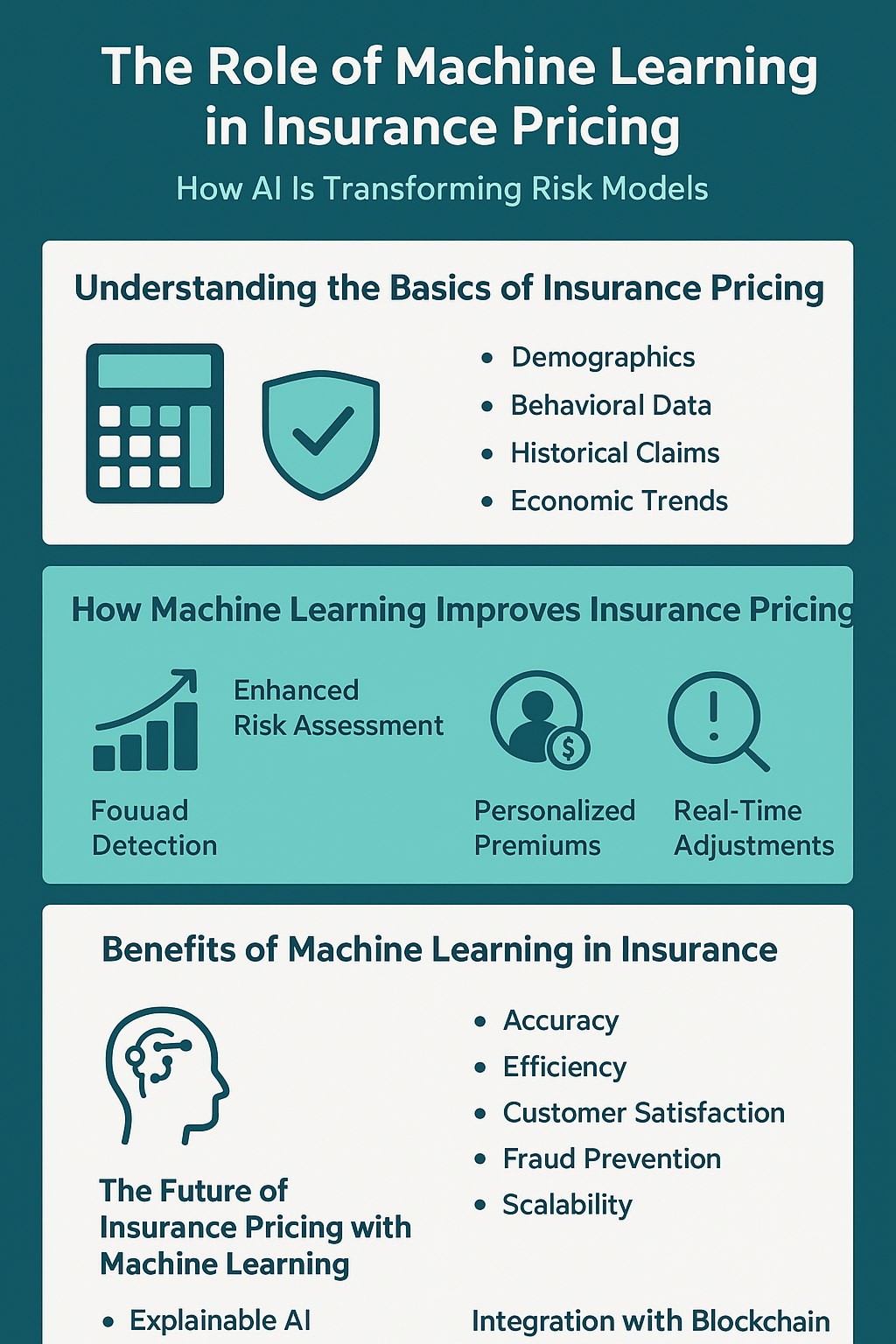
Insurance pricing is the process of determining how much a policyholder should pay for coverage. Traditionally, insurers rely on actuarial tables, historical data, and statistical models. The main goal is to ensure that premiums reflect the level of risk while remaining competitive in the market.
Key factors influencing insurance pricing include:
- Demographics: Age, gender, occupation.
- Behavioral Data: Driving records, lifestyle habits, health conditions.
- Historical Claims: Frequency and severity of past claims.
- Economic Trends: Inflation, interest rates, and regional market dynamics.
While traditional pricing models have worked for decades, they often oversimplify risk assessment. For example, two drivers of the same age and gender may be charged similar premiums despite having vastly different driving behaviors. Machine learning addresses this limitation by incorporating granular data into risk calculations.
The Evolution from Traditional Models to Machine Learning
Historically, insurers used generalized linear models (GLMs) to analyze claim probabilities. GLMs are effective but limited when handling massive, high-dimensional datasets. They struggle with:
- Non-linear relationships among variables.
- Unstructured data like text, images, or sensor data.
- Dynamic risk factors that evolve over time.
Machine learning, on the other hand, thrives in these scenarios. Algorithms such as random forests, gradient boosting machines, and neural networks can process complex datasets, detect subtle patterns, and update predictions as new data becomes available.
How Machine Learning Improves Insurance Pricing
Enhanced Risk Assessment
Machine learning models analyze vast datasets—from driving telematics to wearable health trackers—allowing insurers to calculate risk more precisely. For instance, auto insurers can analyze data on braking patterns, speed variations, and GPS location to differentiate between a cautious driver and a risky one.
Personalized Premiums
Instead of broad categories, ML enables individualized pricing. A health insurer, for example, can adjust premiums based on fitness tracker data, lifestyle behaviors, and preventive healthcare participation.
Fraud Detection
Fraudulent claims are a major cost burden. Machine learning can identify anomalies by comparing claim data against expected patterns. For example, if multiple claims come from the same address in a short timeframe, ML systems can flag them for further investigation.
Real-Time Adjustments
Unlike static actuarial models, ML allows insurers to dynamically update pricing. For example, usage-based car insurance adjusts monthly premiums based on the actual driving behavior recorded by telematics.
Real-World Applications of ML in Insurance Pricing
Auto Insurance
- Telematics devices and apps capture data like mileage, acceleration, and braking.
- Algorithms transform this data into risk scores, creating usage-based insurance (UBI) products.
Health Insurance
- Wearables track activity levels, heart rate, and sleep patterns.
- ML models use this data to predict the likelihood of chronic diseases and adjust premiums accordingly.
Property Insurance
- Satellite imagery, combined with ML, assesses property risks such as flood exposure or fire hazards.
- Real-time data from IoT sensors helps insurers anticipate potential damages.
Life Insurance
- Machine learning models process health records, genetic information, and lifestyle choices.
- These insights help predict life expectancy more accurately than traditional models.
Benefits of Machine Learning in Insurance Pricing
- Accuracy: ML models provide more precise premium calculations.
- Efficiency: Automation reduces the need for manual underwriting.
- Customer Satisfaction: Personalized premiums increase fairness and trust.
- Fraud Prevention: Advanced anomaly detection reduces false claims.
- Scalability: ML can handle millions of data points in real time.
Ethical and Regulatory Challenges
Bias and Fairness
If ML models are trained on biased data, they may reinforce inequalities. For instance, using zip codes in pricing models could indirectly discriminate against certain communities.
Transparency
Black-box algorithms make it difficult for regulators and consumers to understand how prices are determined.
Privacy Concerns
Collecting data from IoT devices, social media, and health apps raises concerns about data privacy and compliance with laws like GDPR and HIPAA.
The Future of Insurance Pricing with Machine Learning
- Explainable AI (XAI): Ensures that pricing decisions are transparent and understandable.
- Integration with Blockchain: Enhances data security and transparency.
- Continuous Learning Systems: Pricing models that adapt automatically as new data emerges.
- Global Adoption: Emerging markets adopting ML-driven microinsurance products.
Conclusion
Machine learning is not just a technological upgrade—it is reshaping the foundations of insurance pricing. From enhancing risk assessment to creating personalized policies, ML empowers insurers to remain competitive in a rapidly changing digital ecosystem. While challenges like bias, transparency, and privacy remain, the future of insurance pricing will undoubtedly be driven by intelligent algorithms that balance fairness, accuracy, and customer trust.