
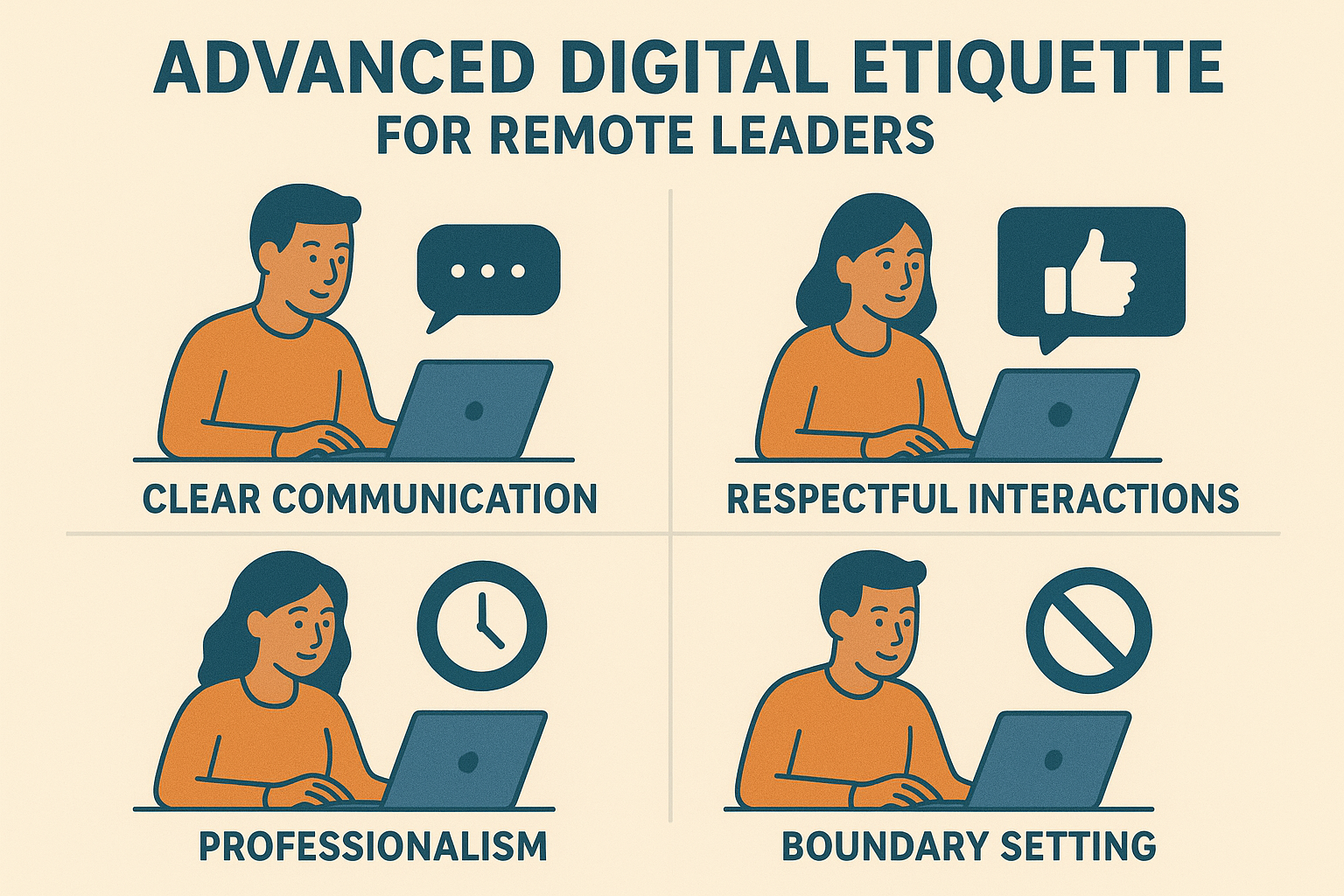
Elevate your virtual leadership. This deep dive into advanced digital etiquette covers async communication, video mastery, and digital body language to build trust, cohesion, and high performance in remote teams.
The Micromanager in Your Keyboard
In the physical office, leadership was conveyed through a handshake, a reassuring smile, an open door, or a casual conversation by the coffee machine. In the remote world, leadership is distilled into pixels, text, and audio bytes. Every Slack message, calendar invite, and video frame is a leadership act. What feels like a small, unconscious digital habit—a message sent at 10 PM, a camera-off meeting, a terse email—can, in aggregate, define your entire effectiveness as a leader.
Advanced digital etiquette is not about remembering to say “please” and “thank you.” It is the sophisticated practice of using digital tools to build trust, foster psychological safety, and convey empathy at a distance. It’s the difference between a leader who merely manages remote workers and one who inspires a truly cohesive, distributed team.
This article is for leaders who have mastered the basics and are ready to explore the nuanced, high-impact strategies that separate adequate virtual management from exceptional digital leadership. We will dissect the subtle art of cyber-fluence—influencing and motivating through screens and text.
Section 1: The New Foundation: From Physical Presence to Digital Intentionality
The core challenge of remote leadership is the phenomenon of “context collapse.” We lose the rich, non-verbal cues that make up over 90% of communication. Advanced etiquette is about intentionally recreating that context.
1.1 The Principle of “Over-Communicating” Context
In an office, people overhear conversations and absorb context passively. Remotely, context must be actively transmitted.
- The “Why” Behind the “What”: Never assign a task without explaining its purpose and how it fits into the larger company goals. A task without context is a chore; a task with context is a mission.
- Visible Workflows: Use project management tools (like Asana or Trello) not just as task lists, but as narratives of progress. A well-updated project board tells a story of momentum and collaboration without requiring a status meeting.
- Documenting Decisions: After a key decision is made in a meeting, send a brief, asynchronous summary to a public channel or wiki. This prevents fragmentation of information and ensures alignment.
1.2 Mastering the Rhythm of Communication
A leader’s communication rhythm sets the team’s pace and stress level.
- The Asynchronous-First Mandate: Default to async communication (Slack, Loom, project management updates) for all non-urgent matters. This respects deep work and time zones. The rule: “Does this need to be a meeting, or can it be resolved async?”
- Synchronous for Connection and Complexity: Reserve real-time communication (video calls) for complex problem-solving, brainstorming, and, most importantly, building social connection.
- Respecting Digital Boundaries: The most critical rule of advanced remote etiquette. Model and enforce healthy boundaries. Avoid sending messages outside of core work hours. Use the “schedule send” feature liberally. Your “always-on” digital presence can create unspoken pressure for your team to do the same, leading to burnout.
Section 2: The Pillars of Advanced Digital Conduct
2.1 Pillar 1: The Etiquette of Asynchronous Communication
This is where most digital friction occurs. Mastering async comms is your superpower.
- The Subject Line is Your Hook: In emails or Slack channels, use descriptive subject lines. Instead of “Update,” use “[Project Phoenix] Q3 Design Mockups Ready for Review.” This allows for efficient triage and search.
- The D.A.C. Framework for Messages: Structure your messages for clarity and action.
- D = Data/Context: The background information needed to understand the request.
- A = Action: The specific request or question. Use bold or highlighting.
- C = Closing/Deadline: The timeline and next steps.
- Example: “Hi Team, (D) Following our win last week with Client A, we have a similar opportunity with Client B. (A) I need the sales team to review the attached proposal and confirm the pricing model is feasible. (C) Please add your comments by EOD Thursday so we can respond promptly.“
- The Power of Video for Nuance: For complex feedback or emotionally sensitive topics, a 2-minute Loom or video message is infinitely better than text. Your tone of voice and facial expression prevent misinterpretation.
2.2 Pillar 2: The Art of the Virtual Meeting
Meetings are the “stage” of remote work. Your conduct here sets the cultural tone.
- The Camera-On Culture (and its Exceptions): Encourage, but don’t mandate, cameras on. Explain the “why”: it builds connection and allows us to read non-verbal cues. As a leader, always have your camera on. However, be empathetic to “camera fatigue” and allow for camera-off moments, especially in long brainstorming sessions.
- Curating Your Digital Presence: Your background, lighting, and audio are part of your digital body language. A cluttered, dark background subconsciously signals disorganization. A clean, well-lit space signals professionalism and respect for the attendees’ time.
- The Ritual of the First Five Minutes: Don’t jump straight into agenda. Dedicate the first 3-5 minutes to human connection. A check-in question (“What’s one good thing that happened this week?”) or casual chat builds the social capital necessary for productive collaboration.
- Inclusive Facilitation: As the leader, you are the facilitator. Actively manage the conversation. “I’d like to hear from Maria on this.” “Thank you for that idea, John. What are others’ thoughts?” Use the “raise hand” feature and chat box to ensure introverted team members have a voice.
2.3 Pillar 3: The Subtleties of Digital Body Language and Feedback
This is the apex of advanced virtual conduct.
- The Etiquette of @Mentions and Channels:
- @channel / @here: Use with extreme caution. This is a digital air horn. Is this message truly urgent for everyone?
- Direct vs. Public Praise: Praise publicly. Offer constructive feedback in a private 1:1 setting. Public criticism in a digital channel creates a lasting, searchable record of shame.
- The “No Surprises” Rule for Feedback: Performance feedback should never be a surprise. This is achieved through continuous, low-stakes check-ins. Use your 1:1s for coaching, not just status updates. The annual review should simply formalize what has already been discussed.
- Reading the Digital Room: Pay attention to signals. Has a usually vocal team member gone quiet in chats? Is there a pattern of delayed responses from one person? This could signal burnout, confusion, or disengagement. This is your cue for a private, empathetic check-in, not a public call-out.
Section 3: Cultivating a Culture of Psychological Safety Digitally
Your digital etiquette is the primary tool for building psychological safety—the belief that one will not be punished for making a mistake or speaking up.
- Leader Vulnerability as a Tool: Admit your own mistakes and learning moments publicly. “I sent that client email without checking X, and it caused some confusion. Here’s what I learned…” This gives everyone else permission to be human.
- Create Explicit “Safe Zones”: Establish dedicated channels or forums for “half-baked ideas” or “stupid questions,” where there is no judgment. Your active participation and encouragement in these spaces is crucial.
- Normalize the “Oops” Post: When something goes wrong, model a blameless post-mortem. “We missed a bug in the last release. Let’s document what happened and how we can improve the process, without pointing fingers.”
Section 4: The Leader’s Toolkit: Practical Applications
- For Onboarding: Assign a “digital buddy.” Record a warm welcome video. Ensure their first week is filled with intentional, scheduled connections, not just async task lists.
- For Project Management: Start each project with a “Team Charter” that defines communication norms, meeting rhythms, and decision-making protocols.
- For Performance Recognition: Go beyond a “good job” in a channel. Send a personalized video message or a handwritten note to their home. The extra effort in a digital world is profoundly meaningful.
Conclusion: From Manager to Digital Conductor
Mastering advanced digital etiquette transforms you from a manager of tasks to a conductor of human potential in a virtual space. It is a continuous practice of empathy, intentionality, and refinement. It’s about understanding that every ping, every pixel, and every punctuation mark is a thread in the tapestry of your team’s culture.
By embracing the principles of contextual over-communication, respectful rhythms, and sophisticated digital body language, you do more than just lead a remote team. You build a resilient, trusting, and highly engaged community that can thrive in the digital age. You stop being a leader who works remotely and become a truly great remote leader.