
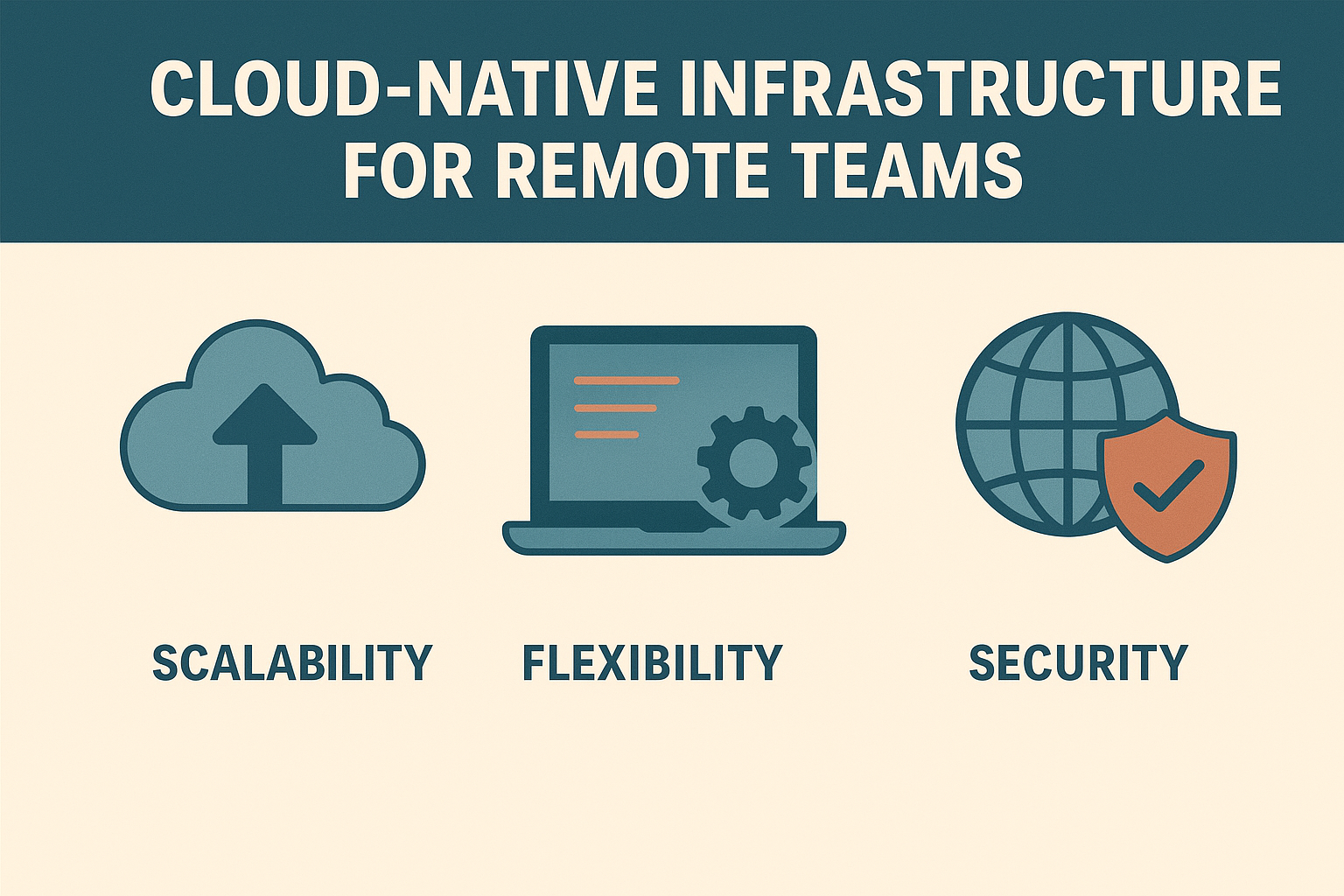
Unlock the full potential of your remote workforce. This guide explores how cloud-native infrastructure—containers, microservices, and DevOps practices—creates a secure, scalable, and collaborative foundation for distributed teams.
The New Foundation for a Borderless Workforce
The exodus from the traditional office is complete. What began as a necessary response to global events has evolved into a fundamental restructuring of how we work. Companies now compete in a war for talent that knows no geographical boundaries. Yet, this newfound freedom exposes a critical weakness: legacy technological frameworks.
Virtual Private Networks (VPNs) buckling under strain, siloed data on local servers, and software that fails to deliver a consistent experience across time zones—these are the symptoms of an infrastructure struggling to support a distributed model.
The solution lies not in patching old systems, but in embracing a new paradigm: cloud-native infrastructure. This is more than just “using the cloud.” It is a holistic approach to building and running applications that leverages modern techniques and technologies to create a resilient, scalable, and dynamic digital environment. For remote teams, this isn’t a technical luxury; it’s the essential bedrock for security, collaboration, and competitive advantage.
This article is a deep dive into how cloud-native principles empower a scattered workforce to operate as a unified, high-performing organization. We will move beyond buzzwords to explore the architectural components, the cultural shifts, and the tangible business outcomes of building a truly digital-first workplace.
Section 1: Deconstructing Cloud-Native – Beyond Lift-and-Shift
Many companies make the initial mistake of a “lift-and-shift” migration, simply moving existing virtual machines to a cloud provider like AWS, Azure, or Google Cloud. While this offers some benefits, it fails to capture the full potential of the cloud.
1.1 The Core Philosophy: Resilience and Scalability as Default
Cloud-native is a philosophy built on four key pillars:
- Elastic Scalability: Resources automatically scale up or down based on real-time demand. A team in London starting its day doesn’t cause latency for a team in San Francisco working late, because the infrastructure adapts seamlessly.
- Inherent Resilience: The system is designed to withstand failures. If a single server or even an entire data center goes offline, the application automatically reroutes traffic to healthy components, ensuring business continuity for a team that could be working from anywhere.
- Automated Operations: Infrastructure is defined as code (IaC), enabling the automated provisioning, deployment, and management of environments. This eliminates manual, error-prone setup and ensures every developer, regardless of location, works with an identical setup.
- Observability: Systems are built to be transparent, providing deep insights into their own performance through centralized logging, metrics, and tracing. This allows a distributed operations team to diagnose and resolve issues without physical access to hardware.
1.2 The Business Imperative for Distributed Organizations
Adopting this model is a strategic business decision that directly addresses the core challenges of remote work:
- Accelerated Innovation (Velocity): Developers can spin up entire testing environments in minutes, not weeks. This decouples teams and allows for parallel workstreams, dramatically reducing the time from idea to production.
- Enhanced Security Posture: A well-architected cloud-native environment can be more secure than a traditional data center. Security policies are codified and applied consistently, and Zero Trust security models can be implemented more effectively.
- Optimized Cost Management: With precise scalability, you pay only for the resources you consume. There are no idle physical servers draining capital expenditure, a crucial advantage for managing operational costs in a dynamic market.
Section 2: The Architectural Pillars of a Cloud-Native Workspace
A robust infrastructure for a distributed team is built on a stack of interconnected technologies.
Pillar 1: The Application Layer – Containers and Microservices
This is the heart of the cloud-native approach, changing how software itself is built and deployed.
- Containers (e.g., Docker): Containers package an application with all its dependencies (libraries, code, runtime) into a single, standardized unit. This guarantees that an application runs identically on a developer’s laptop in Berlin, a testing server in Singapore, and a production cluster in North Virginia.
- Orchestration (e.g., Kubernetes): Kubernetes automates the deployment, scaling, and management of containerized applications. It acts as the “operating system” for the cloud, ensuring that your services are always running and can discover and communicate with each other seamlessly, a critical function for collaborative tools used by remote teams.
- Microservices Architecture: Instead of building a single, monolithic application, the system is broken down into a collection of small, loosely coupled services. This allows small, distributed teams to own, develop, and deploy their services independently, without causing bottlenecks for the entire organization.
Pillar 2: The Development Layer – DevOps and GitOps
The way teams build and deliver software must evolve to support this new infrastructure.
- DevOps Culture and CI/CD Pipelines: DevOps breaks down the silos between development and operations. Combined with Continuous Integration and Continuous Deployment (CI/CD) pipelines, code changes are automatically built, tested, and deployed to production. This creates a rapid, reliable flow of value to end-users, keeping distributed teams productive and aligned.
- Infrastructure as Code (IaC) (e.g., Terraform, Ansible): IaC allows you to define and provision your entire infrastructure (networks, VMs, load balancers) using configuration files. This makes your infrastructure version-controlled, repeatable, and self-documenting, which is invaluable for onboarding new remote engineers and maintaining consistency.
Pillar 3: The Security and Networking Layer – Zero Trust and Service Mesh
In a world without a corporate network perimeter, security must be intrinsic.
- The Zero Trust Model: The principle of “never trust, always verify” is paramount. Every access request, whether from inside or outside the “network,” must be authenticated, authorized, and encrypted. Cloud-native tools are perfectly suited to implement this fine-grained security.
- Service Mesh (e.g., Istio, Linkerd): A service mesh is a dedicated infrastructure layer for managing service-to-service communication. It provides critical capabilities like encrypted mTLS (mutual TLS) by default, observability into traffic flows, and resilient communication patterns like retries and timeouts, securing the “east-west” traffic within your application.
Section 3: Implementing the Framework – A Phased Approach
Transitioning to a cloud-native model is a journey, not a destination.
- Assessment and Strategy: Audit your current applications and team structure. Identify a low-risk, high-value candidate application for migration to prove the value.
- Building the Foundation: Establish the core platform—choose a Kubernetes distribution, set up CI/CD pipelines, and implement basic IaC practices. Upskilling your team is non-negotiable at this stage.
- Modernizing Applications: Begin refactoring monolithic applications into containerized microservices. Start with a single, bounded context to learn the patterns and challenges.
- Optimizing and Scaling: As maturity grows, implement advanced patterns like service meshes, serverless functions, and sophisticated observability platforms to fully leverage the cloud-native ecosystem.
Section 4: The Human Element – Cultivating a Cloud-Native Culture
Technology is only half the battle. The organization must evolve.
- Empowered, Autonomous Teams: The microservices model requires giving small teams full ownership of their services, from development to on-call support.
- Investment in Continuous Learning: The cloud-native landscape evolves rapidly. Create a culture of learning through dedicated training, conference budgets, and internal knowledge-sharing sessions.
- Asynchronous Collaboration: Document everything. With teams spread across time zones, decisions and architectural discussions must be written down in tools like Notion or Confluence, becoming a searchable source of truth.
Section 5: The Future – Serverless and Beyond
The evolution continues toward even higher levels of abstraction.
- Serverless Architectures (e.g., AWS Lambda, Azure Functions): The ultimate expression of cloud-native, where you focus solely on your code without managing any servers. This is ideal for event-driven workflows and can further reduce costs and operational overhead.
- GitOps: An operational model that extends IaC, using Git as a single source of truth for both application code and infrastructure. Any change to the environment is made through a Git commit, ensuring full auditability and streamlined collaboration.
Conclusion: From Cost Center to Strategic Enabler
Building a cloud-native infrastructure for a remote team is not a trivial IT project. It is a strategic transformation that positions technology as a core business enabler. It creates an organization that is inherently more agile, secure, and resilient—one that can attract and retain top global talent and respond to market changes with unprecedented speed.
In the age of distributed work, your digital infrastructure is your workplace. It’s time to build one that is fit for the future.