
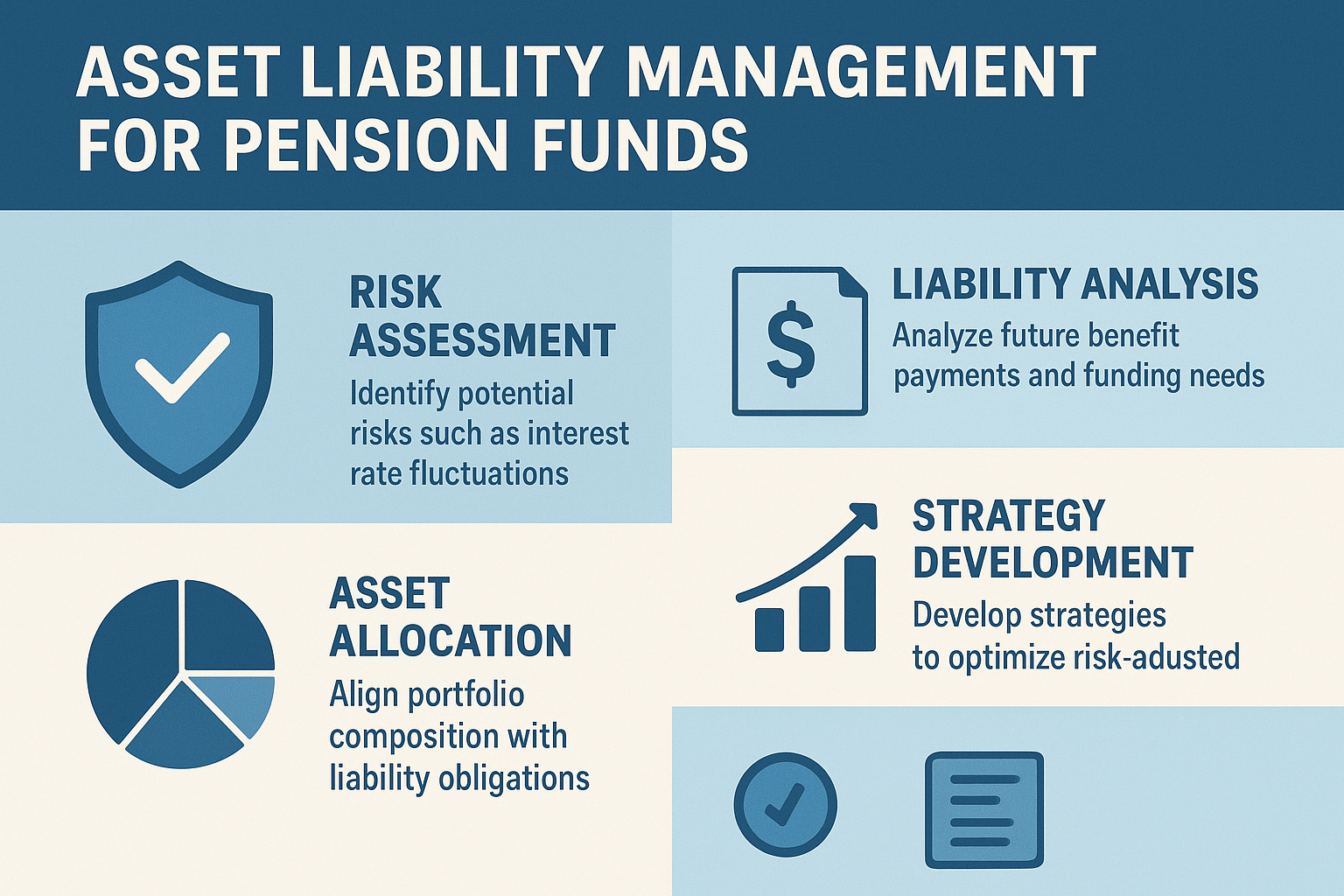
Secure your pension’s future. Our guide explores advanced ALM strategies, liability-driven investing (LDI), duration matching, and hedging techniques to close funding gaps and ensure long-term solvency
The Fiduciary Imperative in an Age of Uncertainty
The global pension industry, overseeing tens of trillions of dollars in retirement assets, stands at a critical juncture. Persistently low interest rates, increasing longevity, and volatile markets have exposed the vulnerabilities of traditional investment approaches. For pension fund trustees and chief investment officers, the challenge is no longer simply about maximizing returns; it is about managing the intricate and dynamic relationship between what they own (assets) and what they owe (liabilities). This discipline, known as Asset Liability Management (ALM), has evolved from a technical accounting exercise into the central strategic pillar of fiduciary duty. This comprehensive guide delves into the sophisticated frameworks and instruments that modern pension funds are deploying to ensure they can meet their promises to beneficiaries for generations to come.
Section 1: The Foundation – Understanding the Pension Liability Universe
1.1 The Nature of the Promise: Defining the Liability Stream
A pension fund’s liabilities are its future pension payments to current and future retirees. Unlike corporate debt, this obligation is long-dated, uncertain, and highly sensitive to economic and demographic factors.
- Projected Benefit Obligation (PBO): The present value of all future benefits earned to date, assuming continued service and future salary increases.
- Accumulated Benefit Obligation (ABO): The present value of benefits earned to date, without assuming future salary increases. A more conservative measure.
1.2 The Key Metric: The Funding Ratio
The health of a pension plan is primarily measured by its funding ratio:
Funding Ratio = (Market Value of Assets) / (Present Value of Liabilities)
A ratio below 100% indicates an underfunded status, creating pressure to contribute more or seek higher returns.
1.3 The Primary Risk Drivers
- Interest Rate Risk: The present value of liabilities is calculated using a discount rate, typically linked to high-quality corporate bond yields. When rates fall, the present value of liabilities rises sharply, worsening the funding ratio—even if asset values remain flat.
- Longevity Risk: The risk that retirees live longer than expected, increasing the total payout period and the value of liabilities.
- Inflation Risk: For plans with inflation-linked benefits, rising inflation can significantly increase the nominal value of future payouts.
Section 2: The ALM Framework – From Policy to Execution
2.1 Strategic Asset Allocation (SAA): The Core of ALM
The SAA is the primary tool for implementing an ALM strategy. It is not about picking stocks; it’s about defining the long-term portfolio structure that aligns with the liability profile.
- The Traditional Approach (60/40 Portfolio): Historically, funds used a simple mix of equities and bonds. This is often misaligned with liabilities, as equity volatility can destabilize the funding ratio.
- The Modern Approach: Liability-Driven Investing (LDI): LDI is the practice of constructing an asset portfolio whose performance correlates with the behavior of the liabilities. The goal is to hedge the key risks, primarily interest rate and inflation risk.
2.2 The LDI Toolkit: Instruments for Hedging
- Government and Corporate Bonds: The foundational hedge. Long-duration bonds can be used to match the duration of the liabilities.
- Interest Rate Swaps: Over-the-counter derivatives that allow a fund to exchange a fixed interest rate for a floating rate, or vice versa. A pension fund can receive a fixed rate to hedge against falling interest rates.
- Inflation-Linked Bonds (e.g., TIPS): Provide a direct hedge against inflation risk, as their principal and coupon payments adjust with the Consumer Price Index (CPI).
- Swaptions: Options on interest rate swaps. They provide insurance against adverse rate moves while allowing participation in favorable ones.
Section 3: Implementing a Robust LDI Strategy
3.1 The Crucial First Step: Liability Modeling and Duration Matching
Before hedging, a fund must understand the precise characteristics of its liabilities.
- Calculating Liability Duration: This measures the sensitivity of the liability’s present value to changes in interest rates. A duration of 15 years means a 1% drop in interest rates will increase the liability value by approximately 15%.
- Asset Duration: The same concept applied to the asset portfolio.
- The Hedging Ratio: The goal is to match asset duration with liability duration. A 100% hedging ratio means the asset portfolio’s value moves in lockstep with the liability portfolio for a given change in rates.
3.2 The Two-Portfolio Approach: A Sophisticated Model
Many large funds now mentally segregate their assets into two portfolios:
- The Hedging Portfolio (LDI Portfolio): Comprised of long-duration bonds, swaps, and other derivatives. Its sole purpose is to hedge interest rate and inflation risk. This portfolio is designed to be low-risk and highly predictable.
- The Return-Seeking Portfolio (Growth Portfolio): Comprised of equities, private equity, real estate, infrastructure, and other alternative assets. This portfolio is designed to generate the excess returns needed to improve the funding ratio, pay benefits, and cover costs. Its risk is now taken within a more stable overall framework.
3.3 De-Risking Glide Paths: A Dynamic Framework
A de-risking glide path is a pre-planned strategy to automatically reduce portfolio risk as the funding ratio improves.
- Mechanism: When the funding ratio reaches a pre-defined trigger (e.g., 90%), the fund systematically sells assets from the return-seeking portfolio and adds to the LDI hedge, locking in the improved funded status.
- Benefits: It removes emotional decision-making and ensures disciplined risk management.
Section 4: The Return-Seeking Engine – Generating Alpha in an LDI World
With core liabilities hedged, the return-seeking portfolio can be optimized.
- The Role of Alternative Assets:
- Private Equity & Venture Capital: Offer illiquidity premiums and potential for high returns to help close funding gaps.
- Real Assets (Real Estate, Infrastructure): Provide inflation-sensitive income and long-term capital appreciation, offering a natural, though imperfect, hedge against inflation.
- Hedge Funds: Strategies like global macro or long/short equity can provide uncorrelated returns, diversifying the growth portfolio.
- Factor Investing: Tilting the equity portfolio towards proven factors like Value, Quality, and Low Volatility to seek more efficient returns.
Section 5: Governance, Modeling, and Stress Testing
5.1 The Role of the Actuary
Actuaries are essential partners, providing the critical liability calculations, demographic projections, and longevity assumptions that drive the entire ALM process.
5.2 Stochastic Modeling and Scenario Analysis
Sophisticated funds use Monte Carlo simulations to model thousands of potential future economic scenarios. This helps answer critical questions:
- What is the probability of achieving a 100% funded status in 10 years?
- What happens to our contributions if we have a decade of low returns?
5.3 Stress Testing the ALM Framework
Regular stress testing against extreme events is crucial.
- Scenario: A simultaneous 30% equity market crash and a 1% drop in interest rates.
- Analysis: The model would show the impact on the funding ratio, testing the resilience of the LDI hedge and the overall strategy.
Section 6: Global Case Studies and Common Pitfalls
- Case Study: The Netherlands & Denmark: Widely regarded as leaders in pension ALM, with high adoption of LDI and robust funding levels.
- Case Study: The 2022 Liability Shock: Rapidly rising interest rates in 2022 dramatically improved the funding status of many U.S. corporate pension plans, allowing them to de-risk aggressively and even transfer liabilities to insurers.
- Common Pitfalls to Avoid:
- Chasing Yield: Taking on excessive credit or liquidity risk in the LDI portfolio to boost returns, which compromises its hedging integrity.
- Hedging Too Late: Waiting for the perfect moment to implement LDI can be costly if rates move adversely.
- Ignoring Governance: Complex derivative strategies require sophisticated oversight and risk management systems.
Conclusion: ALM as a Journey, Not a Destination
Effective Asset Liability Management is not a one-time project but a continuous cycle of measurement, modeling, execution, and review. In a world of economic and demographic headwinds, a robust ALM framework is the pension fund’s most vital defense against insolvency and its most powerful tool for fulfilling its sacred promise to retirees. By embracing a disciplined, liability-aware approach, trustees can navigate market volatility with confidence, ensuring intergenerational equity and long-term sustainability.