
Overview
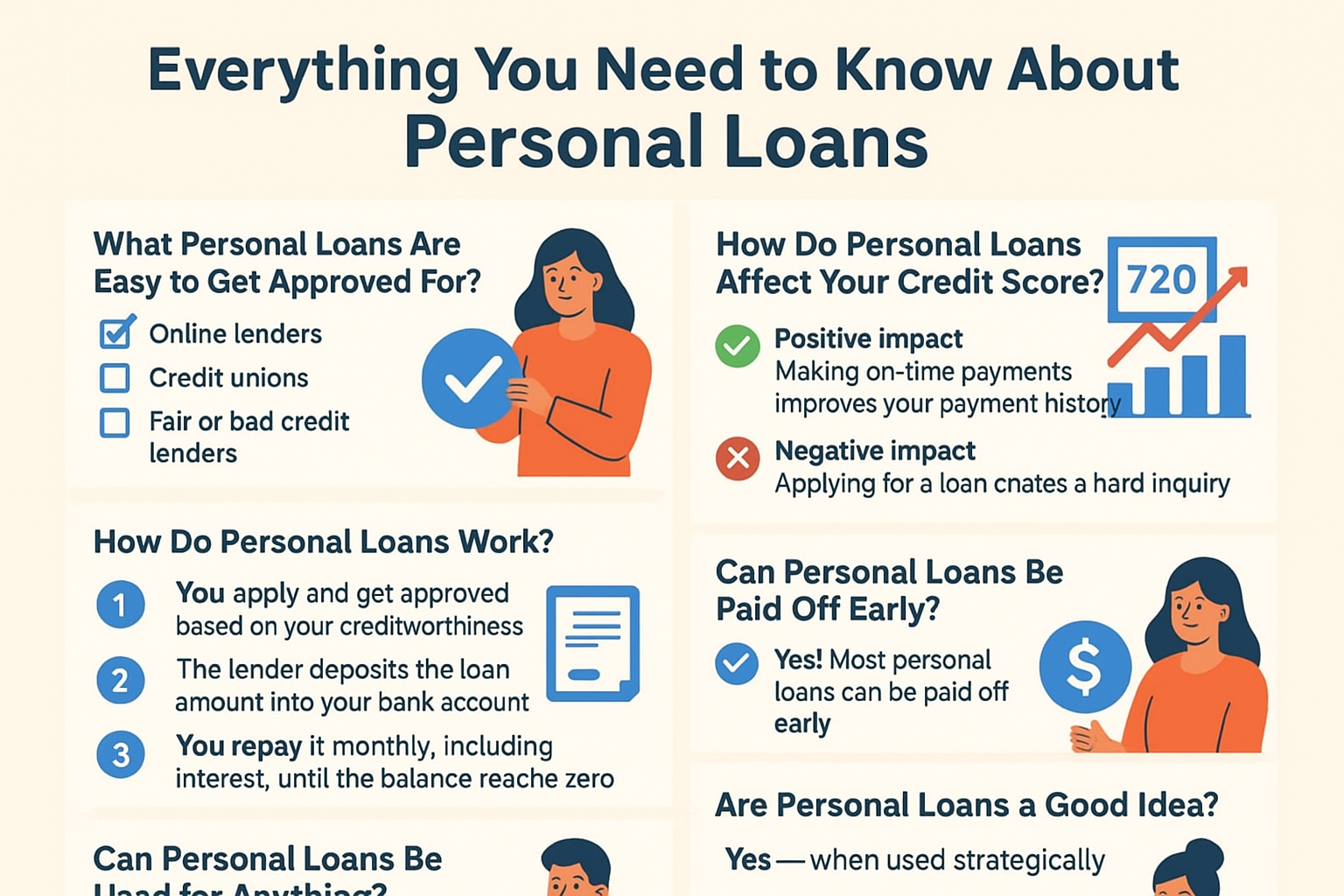
Thinking about a personal loan? This guide answers the most-searched questions in one place—from what’s easiest to get approved for to how loans affect your credit, whether you can pay them off early, what you can use them for, who Achieve Personal Loans is, and if loans are taxable.
What personal loans are easy to get approved for?
“Easy” approval usually means the lender is more flexible—but you’ll often pay more in interest or fees. Safer, more affordable options to consider:
- Secured personal loans: You pledge collateral (a savings account or vehicle). Collateral reduces the lender’s risk and can improve approval odds and pricing. Risk: you could lose the collateral if you default.
- Credit union loans: Many credit unions are friendlier to “fair” or “thin” credit profiles and may offer lower rates than online lenders. Ask about Payday Alternative Loans (PALs) if you only need a small amount.
- Co-signed or joint loans: A co-signer or co-borrower with stronger credit can help you qualify and get a better APR. Both parties are fully responsible for repayment.
- Smaller loan amounts and shorter terms: Asking for less money or choosing a shorter repayment term can boost approval chances.
- Lenders that serve fair/average credit: Some online lenders specialize in approving borrowers with scores in the mid-600s. Always compare total cost and fees.
Approval tips:
- Pre-qualify with a soft credit check before you apply (won’t affect your score).
- Pay down credit card balances to lower utilization.
- Check your credit reports for errors and dispute inaccuracies.
- Aim for a debt-to-income (DTI) ratio under ~36–45%.
- Document stable income; consider adding a co-signer if needed.
Avoid: Predatory products like payday or title loans—fast approvals but extremely high costs and risk.
How do personal loans work?
- Fixed amount and term: You borrow a lump sum and repay it in fixed monthly payments over a set period (commonly 1–7 years).
- APR and fees: Your cost is expressed as an APR (interest rate plus any required fees like an origination fee). Some lenders charge 0–10% origination; others charge none.
- Unsecured vs. secured: Most personal loans are unsecured (no collateral). Secured loans may offer better rates but require collateral.
- Funding: Once approved, funds arrive as a direct deposit or, for debt consolidation, may be sent directly to your creditors.
- Interest method: Most use simple interest (you save interest if you pay early). Ask the lender to confirm it’s not “precomputed” interest.
How do personal loans affect your credit score?
- Hard inquiry: Applying typically causes a small, temporary dip (a few points).
- New account and age: Opening a new account lowers the average age of your credit, which can nudge your score down initially.
- Payment history: On-time payments can build your score over time; late payments hurt significantly.
- Credit mix: Adding an installment loan can slightly help your score if you previously only had revolving credit (credit cards).
- Revolving utilization: If you use a loan to pay off credit cards, your card utilization falls, which can boost your score.
Will personal loans build credit?
Yes—if:
- The lender reports to all three major bureaus (Experian, Equifax, TransUnion), and
- You make on-time payments every month.
Tip: Turn on autopay and set reminders. One 30-day late payment can cause a large score drop.
Will personal loans affect your credit?
Absolutely. Beyond your score, a new loan affects your credit profile and future borrowing:
- In the short term, the hard inquiry and new account can modestly lower your score.
- Over time, consistent on-time payments help your history and credit mix.
- A high monthly payment increases DTI, which lenders consider when you apply for other credit.
- Missed payments, defaults, or collections severely damage your credit.
Can personal loans be paid off early?
Usually yes—and it’s often a smart way to save on interest. Before you do:
- Check for a prepayment penalty: Most personal loans don’t have one, but verify your agreement.
- Ask for a payoff quote: Interest accrues daily; a quote tells you the exact amount to settle on a specific date.
- Keep autopay on until the final payment clears: Then confirm the account is closed with a $0 balance.
Note: Paying off early can slightly reduce your “credit mix” benefit, but the interest savings typically matter more.
Can personal loans be used for anything?
Generally, yes—any legal, personal purpose, including:
- Debt consolidation
- Emergency expenses or medical bills
- Moving costs, weddings, or travel
- Home repairs or small renovations
Common restrictions:
- Postsecondary education tuition
- Real estate down payments
- Business purposes (some lenders allow it; many don’t)
- Buying investments or cryptocurrency
- Illegal purposes
Always check the lender’s permitted-use policy.
Who is Achieve Personal Loans?
Achieve is a U.S.-based personal finance company (the brand is associated with the team behind Freedom Financial Network). Achieve Personal Loans are typically unsecured, fixed-rate installment loans offered online, often including options for debt consolidation (some lenders can pay creditors directly). Specific terms, fees, and eligibility depend on the offer and partner banks involved. Always review the lender’s disclosures and compare multiple quotes before deciding. This mention is for information only—not an endorsement.
Are personal loans bad?
They aren’t inherently “bad,” but they can be harmful if:
- The APR is high and you could qualify for cheaper alternatives.
- You use them for discretionary spending and continue to carry credit card balances.
- There are steep fees or a prepayment penalty you can’t avoid.
- You don’t have a realistic plan to repay.
Are personal loans a good idea?
They can be a good idea when they:
- Replace higher-interest credit card debt with a lower, fixed APR and a clear payoff date.
- Help you cover a necessary, unexpected expense at a reasonable cost.
- Fit your budget (payment comfortably fits your cash flow) and help you avoid revolving debt.
Alternatives to compare:
- 0% APR balance transfer credit cards (if you can pay off during the promo period)
- Credit union loans
- Home equity (if you’re a homeowner and comfortable with collateral risk)
- Building an emergency fund for future needs
Are personal loans taxable?
- Loan proceeds: Not taxable income in the U.S. because you’re obligated to repay them.
- Interest: Generally not tax-deductible for personal use.
- Exceptions: Interest may be deductible if the loan is used for qualified business, investment, or certain tax-deductible purposes (subject to IRS “tracing” rules and limits). Consult a tax pro.
- Canceled/forgiven debt: May be taxable as income, and you could receive a Form 1099-C (exceptions can apply, e.g., insolvency).
- Bonuses: Cash incentives or referral bonuses could be taxable income.
Quick decision checklist
- Purpose: Is it need-to-have, not nice-to-have?
- Total cost: Compare APRs and origination fees across at least 3–5 lenders.
- Pre-qualify: Use soft checks to see rates without impacting your score.
- Monthly payment: Fits your budget even in a “bad month”?
- Term: Shorter terms cost less interest overall.
- Fine print: Any prepayment penalties or restrictive use?
- Plan: If consolidating, close or lock away paid cards so you don’t re-accumulate debt.
FAQ (fast answers using your exact questions)
- What personal loans are easy to get approved for? Secured loans, credit union loans, co-signed loans, smaller amounts, and lenders that serve fair credit are typically easier; avoid predatory high-cost loans.
- How do personal loans affect credit score? Small dip from the hard inquiry and new account; potential score growth from on-time payments, improved credit mix, and lower card utilization after consolidation.
- How do personal loans work? You get a lump sum, repay in fixed monthly payments over a set term, and pay an APR that may include fees.
- Can personal loans be paid off early? Usually yes—verify no prepayment penalty and request a payoff quote.
- Can personal loans be used for anything? Most legal personal uses are allowed; common restrictions include education tuition, business use (varies), investing, and real estate down payments.
- Who is Achieve Personal Loans? An online personal loan offering from Achieve, a U.S. personal finance company; terms vary by offer and partner banks.
- Will personal loans build credit? Yes, if the lender reports to bureaus and you pay on time.
- Will personal loans affect your credit? Yes—both positively (on-time history, mix) and negatively if you miss payments; there’s a small short-term dip when you open the loan.
- Are personal loans bad? Not by default; they can be costly or risky if misused or if the APR/fees are high.
- Are personal loans a good idea? They can be, especially for consolidating higher-interest debt into a lower fixed rate with a clear payoff plan.
- Are personal loans taxable? Proceeds aren’t taxable; interest usually isn’t deductible for personal use; forgiven debt may be taxable.
This content is for general educational purposes and focuses on U.S. rules; it’s not financial or tax advice. Consider speaking with a qualified professional for your situation.