
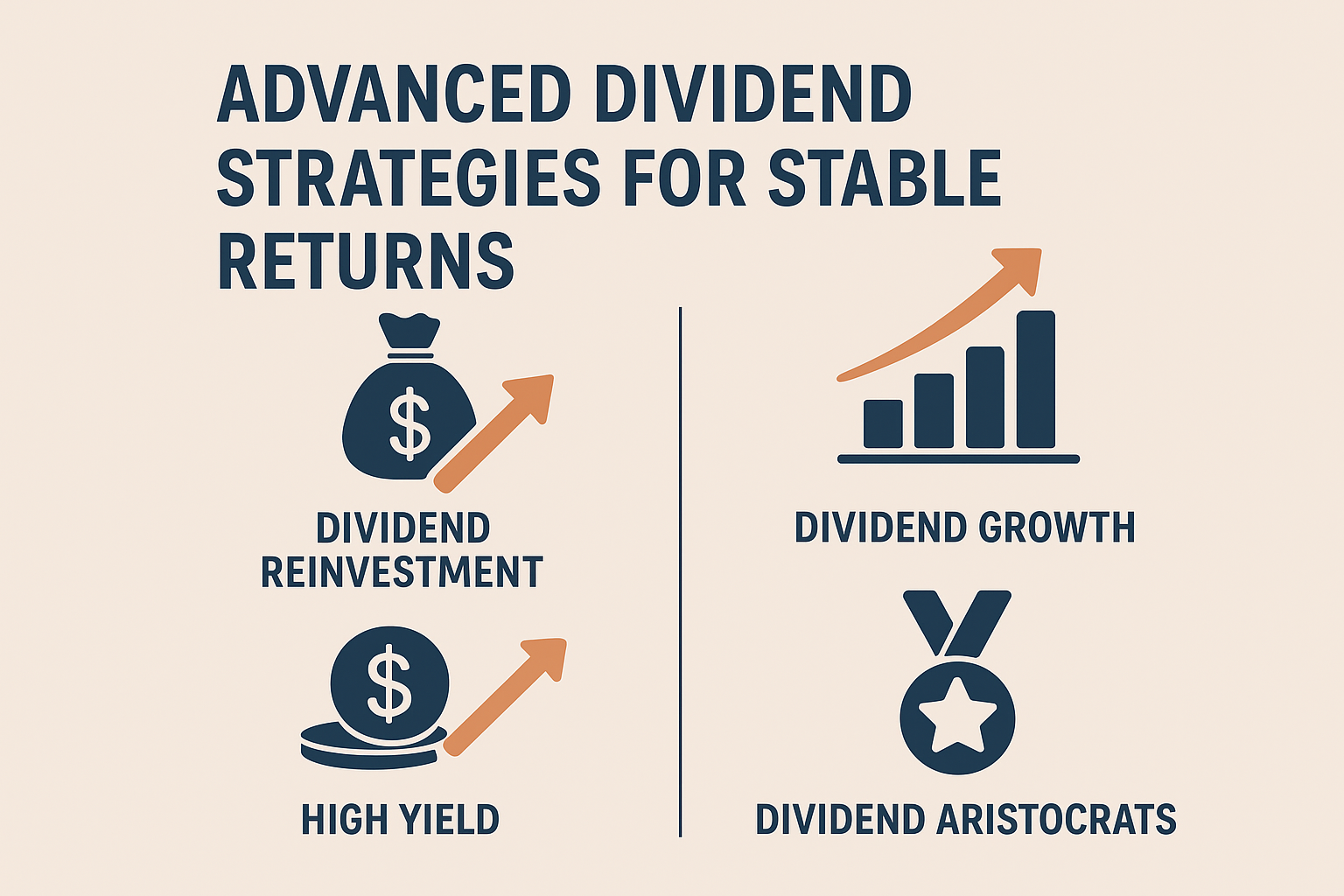
💰 Tired of paltry yields and dividend cuts? Discover advanced dividend strategies used by professional income investors. We reveal the 3-pillar safety framework, how to use covered calls for 30% more income, and the #1 mistake to avoid. Click to learn how to build a truly durable income portfolio.
The Quest for Quality in a Yield-Starved World
In an investment landscape often dominated by speculative growth stories and macroeconomic noise, the timeless appeal of dividend income remains a beacon of stability. However, the simplistic pursuit of the highest yield is a dangerous game, often leading investors into “yield traps”—companies whose unsustainable payouts are a prelude to dividend cuts and capital depreciation. Advanced dividend strategies are not about chasing yield; they are about engineering a durable and growing stream of cash flow from high-quality businesses.
This approach represents a shift from being a passive income collector to an active architect of sustainable income generation. It combines the discipline of fundamental analysis with sophisticated portfolio management techniques to achieve what every income investor truly desires: a reliable and increasing payout that withstands economic cycles and compounds wealth over time.
This definitive guide will take you beyond the basics. We will explore how to identify truly reliable payout methods, implement powerful yield enhancement techniques, and construct a low-volatility income portfolio designed to provide stability and growth through any market environment.
Chapter 1: The Foundation – The Pillars of Dividend Sustainability
Before implementing any advanced strategy, one must master the art of distinguishing a robust dividend from a fragile one.
The Dividend Safety Framework: Analyzing the Source of the Cash Flow
A sustainable dividend is backed by a healthy business, not financial engineering. The key metrics for dividend safety analysis include:
- Payout Ratio: The percentage of earnings paid out as dividends. A ratio below 60% is generally safe, but this varies by industry.
- Free Cash Flow Payout Ratio: A more reliable metric. It measures the dividend as a percentage of Free Cash Flow (Operating Cash Flow minus Capital Expenditures). A ratio consistently below 80-90% is a strong sign of safety.
- Debt-to-Equity Ratio: Highly leveraged companies are vulnerable during economic downturns and may cut dividends to service debt.
- Track Record: Companies with a long history of paying and raising dividends—the so-called Dividend Aristocrats and Dividend Kings—have a culture of shareholder returns that is hard to break.
The Quality Compounder Mindset
The most powerful dividend growth model focuses on companies that consistently grow their earnings. A growing earnings base is the engine that fuels a growing dividend. Seek businesses with:
- Durable competitive advantages (wide moats).
- Strong brand loyalty and pricing power.
- Exposure to non-cyclical or growing end markets.
Chapter 2: The Core Strategy – Systematic Dividend Growth Investing
This is the cornerstone of advanced dividend investing for stable returns.
The Philosophy: Yield on Cost is the True North
Instead of focusing on the current yield, the dividend growth investor focuses on the future “yield on cost”—the annual dividend divided by the original purchase price. A stock yielding 2.5% that grows its dividend at 10% annually will see its yield on cost rise to over 10% in 15 years.
Implementation: Building a Portfolio of Aristocrats and Champions
- Screening Criteria: Look for companies with:
- A minimum 10-year history of consecutive dividend increases.
- A sustainable payout ratio (both earnings and FCF).
- A history of earnings growth that outpaces dividend growth.
- A manageable debt load.
- Sector Allocation: A quality compounders portfolio will naturally be overweight in sectors like Consumer Staples, Healthcare, and Industrials, which have stable cash flows.
The Power of the Dividend Growth Model
The value of a dividend growth stock can be modeled as the present value of its future dividend stream. This framework forces the investor to think about the longevity and growth rate of the payout, anchoring the strategy in intrinsic value.
Chapter 3: The Income Amplifiers – Sophisticated Yield Enhancement Techniques
For investors seeking to augment their income stream, several advanced dividend strategies can be carefully employed.
1. The Covered Call Strategy
This is a premier yield enhancement technique for investors who own stable, dividend-paying stocks.
- Mechanics: An investor who owns 100 shares of a stock sells (writes) a call option against that position, giving someone else the right to buy the shares at a set price (strike price) before a certain date.
- Income Boost: The investor collects the option premium immediately, which enhances their income on top of the dividend.
- The Trade-Off: The upside potential is capped. If the stock rises significantly above the strike price, the shares will be “called away.”
- Best For: Range-bound or slowly rising markets and stocks with high option premiums.
2. The Dividend Capture Strategy – A Risky Gambit
This tactical approach involves buying a stock just before its ex-dividend date and selling it shortly after to capture the dividend.
- Reality Check: This is often a loser’s game for most retail investors due to:
- Transaction costs eroding the small dividend gain.
- Price volatility around the ex-dividend date (the stock price typically drops by the amount of the dividend).
- Tax inefficiency (dividends are often qualified, while short-term gains are taxed at a higher rate).
- Advanced Twist: It can only be profitable in specific conditions, such as with very high-yield stocks in a tax-advantaged account with zero commission trading, and even then, it carries significant risk.
Chapter 4: The Portfolio Architecture – Building a Resilient Income Ecosystem
A collection of dividend stocks is not a strategy; a thoughtfully constructed portfolio is.
Strategic Diversification Beyond Sectors
- By Dividend Policy:
- High-Yield, Low-Growth: (e.g., Utilities, Telecoms) for current income.
- Low-Yield, High-Growth: (e.g., Quality Tech, Financials) for future yield-on-cost growth.
- “Sweet Spot” Compounders: (e.g., Consumer Staples, Industrials) offering a balance of both.
- By Geography: Including international dividend payers can provide diversification and access to different economic cycles.
The Role of Dividend Reinvestment Plans (DRIPs)
A powerful tool for cash flow compounding.
- Traditional DRIPs: Automatically reinvest dividends into more shares of the same stock, often without commission.
- Synthetic DRIPs: Using a broker’s fractional share program to automatically reinvest dividends across your entire portfolio according to your target allocation.
The “Income Bucket” Approach for Retirees
A practical income-focused allocation strategy:
- Bucket 1 (Cash & Equivalents): 1-2 years of living expenses in cash.
- Bucket 2 (Stable Income): 3-10 years of expenses in high-quality bonds and dividend-paying stocks.
- Bucket 3 (Long-Term Growth): The remainder in dividend growth stocks for inflation-beating income growth.
This structure provides peace of mind, allowing the long-term portfolio to recover from downturns without forcing the sale of assets at depressed prices.
Chapter 5: Navigating the Pitfalls – Avoiding Common Dividend Traps
Sophisticated investors are defined as much by what they avoid as by what they buy.
The High-Yield Trap
The siren song of a double-digit yield is often a warning sign. A yield becomes unsustainably high when the market prices in a high probability of a dividend cut. Always ask: “Why is the yield so high?”
The Value Trap with a Dividend
A company may look cheap on metrics like P/E and sport a high yield, but if its business model is in secular decline (e.g., legacy media, traditional retail), the dividend is likely on borrowed time.
Sector-Specific Risks
- REITs & MLPs: Their high yields are often a function of their legal structure, which requires them to pay out most of their income. They are highly sensitive to interest rates and sector-specific cycles.
- Cyclical Industries: Dividends from automakers, commodity producers, etc., can be plentiful at the peak of the cycle but are often the first to be cut in a downturn.
Chapter 6: The Future of Dividend Investing – Trends and Adaptation
The landscape for dividend investing is evolving.
The Rise of “Tech Dividends”
The technology sector, once a dividend desert, is now maturing. Companies like Apple, Microsoft, and Cisco have become significant and growing dividend payers, offering a new source of quality compounders for income portfolios.
ESG Integration and Dividend Sustainability
There is a growing correlation between strong Environmental, Social, and Governance (ESG) practices and dividend safety. Companies with good governance are less likely to make reckless decisions that jeopardize their payouts.
The Impact of Interest Rates
In a higher-rate environment, the competition from “risk-free” bonds increases. This puts pressure on the valuations of traditional high-yield equities but rewards those companies with strong dividend growth that can outpace inflation.
Conclusion: The Disciplined Path to Durable Income
Advanced dividend strategies are a testament to the power of discipline, patience, and a focus on quality. They move the investor from a passive recipient of income to an active manager of a cash-flow engine. The goal is not to find the highest yielder today, but to build a portfolio of resilient businesses that will reliably fund your tomorrows.
This journey requires a commitment to rigorous analysis, a long-term perspective, and the emotional fortitude to ignore the siren call of speculative yield. By focusing on sustainable income generation through dividend growth investing and prudent yield enhancement techniques, you can construct a portfolio that provides not just income, but peace of mind—the ultimate stable return.