
Stop overpaying for opaque funds and missing illiquid altcoins. Our definitive guide reveals how blockchain tokenization is democratizing access to real estate & private equity, while smart contracts automate compliance. Learn the strategies for the new digital asset era.
A Paradigm Shift in Finance
The world of asset management, long characterized by centralized intermediaries, complex settlement processes, and opaque record-keeping, is on the cusp of a profound transformation. While often synonymous with cryptocurrencies like Bitcoin, the underlying technology—blockchain, or more broadly, Distributed Ledger Technology (DLT)—holds far greater potential. This innovative framework promises to dismantle longstanding inefficiencies, unlock new value, and democratize access to investment opportunities. This article delves deep into the practical applications of this groundbreaking technology within the asset management industry, moving beyond the hype to explore a future defined by tokenization, automated compliance, and unprecedented operational integrity.
Understanding the Core: What is Blockchain and DLT?
Before exploring its applications, it’s crucial to grasp the fundamental principles that make this technology so disruptive.
- Distributed Ledger: Unlike a traditional database controlled by a single entity (like a bank or a custodian), a blockchain is a decentralized ledger duplicated and distributed across a network of computers. Each participant (or node) has an identical copy.
- Immutability and Cryptography: Once a transaction is recorded and verified by the network consensus mechanism, it is encrypted and linked to the previous transaction, forming a “chain.” Altering any record would require changing all subsequent blocks across the majority of the network, making it practically impossible to tamper with.
- Transparency and Anonymity: While transactions are transparent and verifiable by all network participants, the identities of the parties involved can be protected through cryptographic techniques, ensuring privacy where needed.
- Smart Contracts: These are self-executing contracts with the terms of the agreement directly written into code. They automatically execute and enforce obligations when predefined conditions are met, eliminating the need for intermediaries.
The Pain Points of Traditional Asset Management
To appreciate the value DLT brings, we must first acknowledge the inefficiencies it aims to solve:
- Operational Inefficiency and High Costs: The current system relies on a web of intermediaries—brokers, custodians, transfer agents, and clearinghouses—each adding layers of complexity, time, and cost. Reconciliation of records between these parties is a manual and error-prone process.
- Lack of Transparency: Investors often have limited visibility into the real-time performance and underlying holdings of their assets. This opacity can breed mistrust and complicate auditing processes.
- Illiquidity in Alternative Assets: Investing in high-value assets like real estate, fine art, or private equity is often restricted to institutional players due to high minimums and notoriously illiquid markets.
- Slow Settlement Times: The traditional financial system, especially for securities, can take days (T+2 or T+1) to settle trades, tying up capital and introducing counterparty risk.
- Fraud and Cybersecurity Risks: Centralized databases are attractive targets for hackers. Fraudulent activities, such as the creation of fake shares or identity theft, remain a persistent threat.
Core Applications of Blockchain in Asset Management
1. The Tokenization of Assets: Unlocking New Markets
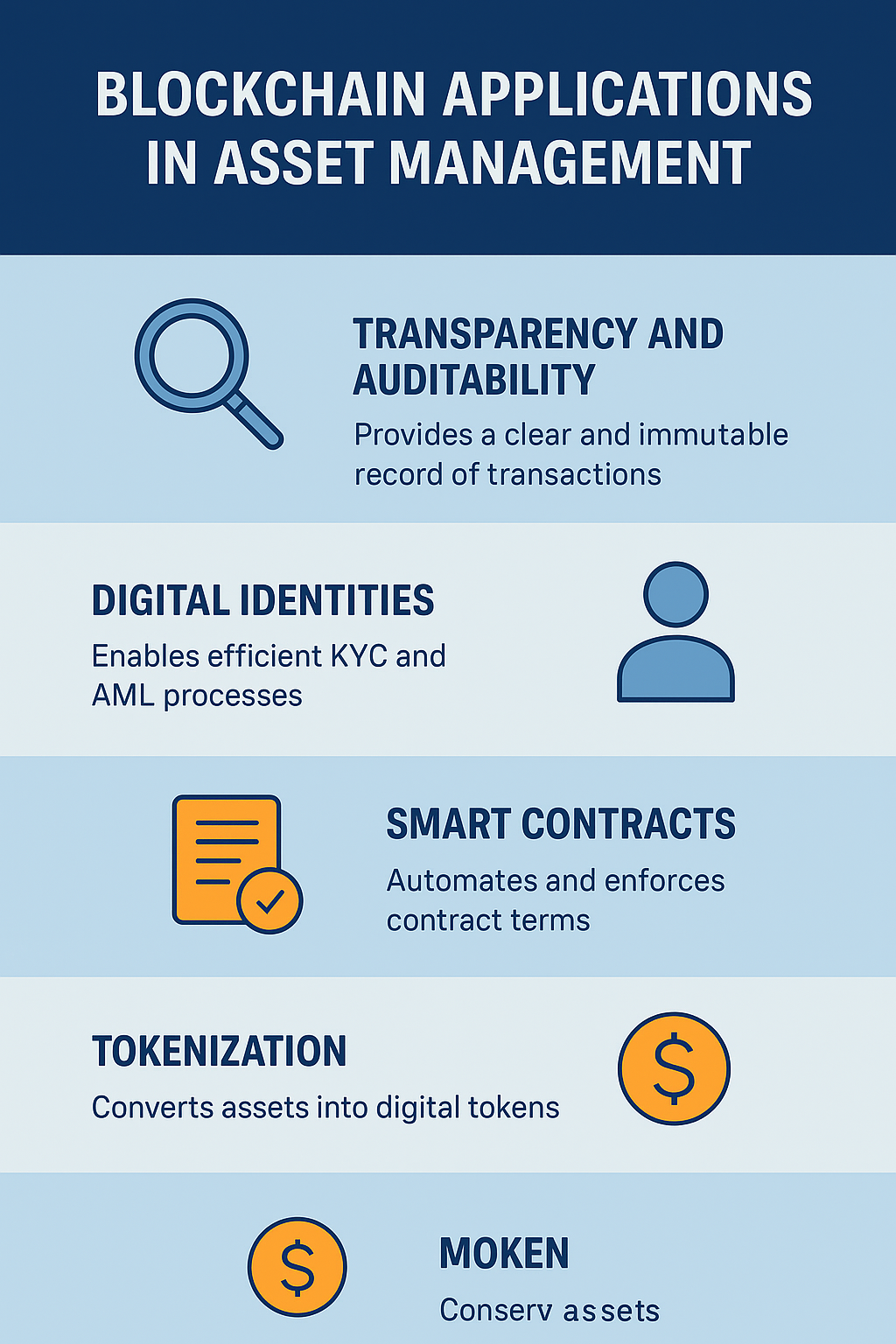
Tokenization is the process of converting rights to a real-world asset into a digital token on a blockchain. This is arguably the most significant application of DLT in this sector.
- How it Works: An asset—be it a building, a painting, a company’s stock, or a government bond—is legally represented by a number of digital tokens. Each token signifies a fractional ownership stake.
- Real-World Example: A $50 million commercial property can be tokenized into 5 million tokens, each representing a $10 share. This allows retail investors to own a piece of a previously inaccessible asset.
- Benefits:
- Fractional Ownership: Lowers the barrier to entry for expensive asset classes.
- Enhanced Liquidity: Creates secondary markets for traditionally illiquid assets, allowing for 24/7 trading.
- Automated Governance: Dividend distributions or profit-sharing can be automated via smart contracts, ensuring timely and accurate payments to all token holders.
2. Revolutionizing Trade Lifecycle and Settlement
DLT can streamline the entire post-trade process, from execution to settlement.
- The Concept of “Delivery vs. Payment” (DvP): On a blockchain, the exchange of the asset (e.g., a security token) and the payment (e.g., a stablecoin or CBDC) can occur simultaneously in an atomic swap. This means the transfer of ownership and the payment are a single, indivisible operation.
- Impact: This reduces settlement time from days to minutes or even seconds. It also eliminates counterparty risk—the risk that one party fails to deliver—as the transaction either completes fully or not at all.
- Reduced Reconciliation: With a single, shared source of truth, all parties involved in a trade (buyer, seller, brokers, custodians) see the same data in real-time, virtually eliminating reconciliation needs and associated costs.
3. Smart Contracts for Automated Compliance and Operations
Smart contracts bring unparalleled automation and precision to back-office functions and regulatory adherence.
- Programmable Compliance (RegTech): Regulatory rules, such as Know Your Customer (KYC) and Anti-Money Laundering (AML) checks, can be embedded into the blockchain. Once an investor is verified, their status can be shared (with consent) across multiple platforms, avoiding repetitive checks.
- Automated Corporate Actions: Events like dividend payments, stock splits, and interest payments can be coded into smart contracts. They execute automatically on the specified date, reducing administrative overhead and human error.
- Dynamic Fund Management: The rules of an investment fund (e.g., a rule stating “no more than 10% allocation to a single asset”) can be enforced in real-time by smart contracts, preventing manual breaches.
4. Unprecedented Transparency and Auditability
Every transaction on a permissioned blockchain (a private network where participants are known and vetted) is time-stamped, cryptographically signed, and permanently recorded.
- Immutable Audit Trail: Auditors can be granted access to the ledger to verify the complete history of an asset’s ownership and transactions, significantly speeding up the audit process and enhancing its reliability.
- Provenance and ESG Tracking: For assets where provenance is key (e.g., conflict-free diamonds, sustainable timber) or for ESG (Environmental, Social, and Governance) funds, DLT can provide an immutable record of an asset’s journey, from origin to end-investor, verifying its ethical credentials.
Overcoming the Hurdles: Challenges and Considerations
The path to widespread adoption is not without obstacles:
- Regulatory Uncertainty: Governments and regulatory bodies worldwide are still grappling with how to classify and regulate digital assets and the platforms that trade them.
- Scalability and Interoperability: Some blockchain networks face limitations in transaction throughput. Furthermore, for the ecosystem to thrive, different blockchains and traditional systems need to be able to communicate seamlessly.
- Integration with Legacy Systems: Asset managers have trillions of dollars tied up in legacy infrastructure. Integrating novel DLT solutions with these old systems is a complex and costly challenge.
- Cultural and Industry Adoption: A shift of this magnitude requires a change in mindset and collaboration across the entire financial industry, from incumbents to disruptors.
The Future Landscape: A Glimpse into the Next Decade
The convergence of DLT with other technologies like AI and the IoT will further accelerate its impact.
- The Rise of Decentralized Finance (DeFi): We will see the emergence of more sophisticated DeFi protocols for lending, borrowing, and derivatives, built directly on blockchain networks, competing with traditional services.
- Central Bank Digital Currencies (CBDCs): The advent of CBDCs will provide the perfect digital currency rails for settling tokenized assets, creating a fully integrated digital financial ecosystem.
- AI-Powered On-Chain Analytics: Artificial intelligence will be used to analyze the vast amounts of data on public blockchains, providing deep insights into market sentiment, risk, and investment opportunities.
Conclusion: An Inevitable Evolution
The integration of blockchain technology into asset management is not a question of “if” but “when.” While challenges remain, the benefits of increased efficiency, reduced costs, enhanced liquidity, and fortified trust are too significant to ignore. The industry is moving from a model of centralized control to one of decentralized verification and collaboration. For asset managers, embracing this technological shift is no longer a speculative gamble but a strategic imperative to stay relevant, competitive, and trusted in the financial landscape of tomorrow.