
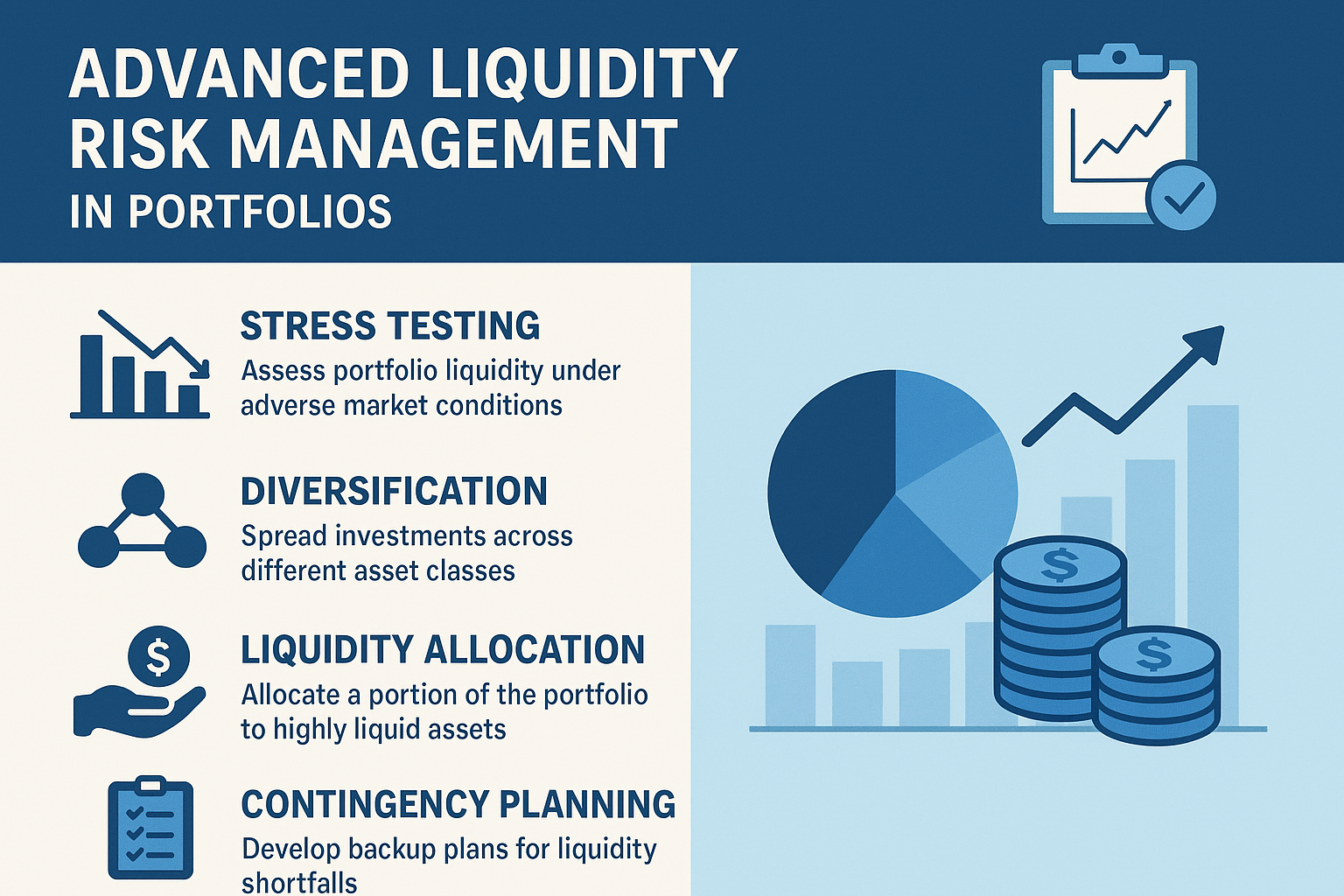
Is your portfolio prepared for the next ‘Dash for Cash’? Master Advanced Liquidity Risk Management with our guide to stress testing, asset-liability matching, and building a strategic liquidity cushion. Transform your biggest hidden risk into a durable advantage
The Illusion of Liquidity in Modern Portfolios
The 2008 Financial Crisis, the 2020 “Dash for Cash,” and the 2022 UK Gilts crisis served as stark reminders: liquidity is the oxygen of financial markets, and its sudden disappearance can be fatal. For too many portfolio managers, liquidity risk is narrowly defined as the bid-ask spread of publicly traded equities. This is a dangerous oversimplification. Advanced liquidity risk management is a holistic, strategic discipline that encompasses funding needs, market depth, asset-liability matching, and the complex interplay during periods of systemic stress. This in-depth guide is designed for institutional investors, family offices, and sophisticated portfolio managers who recognize that true resilience lies not just in asset selection, but in mastering the intricate art of navigating exit strategies under duress.
Section 1: Deconstructing Liquidity: A Multi-Dimensional View
1.1 The Two Pillars: Asset Liquidity vs. Funding Liquidity
A sophisticated framework begins by distinguishing between these two critical, and often correlated, dimensions:
- Asset Liquidity (Market Liquidity): The ease with which an asset can be bought or sold in the market without significantly affecting its price. This is influenced by:
- Tightness: The bid-ask spread.
- Depth: The volume of orders on the order book.
- Resiliency: The speed at which prices recover from a random shock.
- Funding Liquidity: The ability to meet cash flow obligations and collateral calls without incurring unacceptable losses. A portfolio can be rich in assets but poor in funding liquidity if those assets cannot be monetized quickly.
The fatal spiral occurs when these two interact: a need for funding liquidity (a margin call) forces the sale of assets into an illiquid market (poor asset liquidity), leading to fire sales and further losses, triggering more margin calls.
1.2 The Liquidity Spectrum: From Cash to Exotic Alternatives
Placing assets on a spectrum is foundational. This spectrum has shifted dramatically with the proliferation of exotic instruments.
- High Liquidity: Cash, Sovereign Bonds (US Treasuries, German Bunds), large-cap equities.
- Medium Liquidity: Small-cap equities, corporate bonds (especially high-yield), certain ETFs.
- Low Liquidity: Bank loans, physical real estate, structured products.
- Very Low Liquidity: Private equity, venture capital, private credit, infrastructure, collectibles.
Section 2: The Advanced Quantitative Toolkit: Moving Beyond Basic Metrics
2.1 Liquidity-Adjusted Value at Risk (La-VaR)
Traditional VaR measures potential loss based on price volatility. La-VaR incorporates the cost of liquidation, factoring in the bid-ask spread and the market impact of selling a position over a specific time horizon. It provides a more realistic, and often alarming, view of potential losses during a crisis.
2.2 The Liquidity Stress Test (LST)
This is the cornerstone of a robust framework. It involves simulating extreme but plausible scenarios to assess the portfolio’s resilience.
- Scenario Design:
- Idiosyncratic Stress: A major position in the portfolio suffers a credit downgrade or a company-specific scandal.
- Market-Wide Stress: A 2008 or 2020-style event where correlations converge to 1 and liquidity evaporates across asset classes.
- Funding Shock: A sudden redemption wave from investors or a sharp increase in collateral requirements from prime brokers.
- Output Analysis: The test answers critical questions: What is the liquidation cost? How long would it take to raise a specific amount of cash? Which assets become “toxic” and unsellable?
2.3 Liquidity Bucketing and the Liquidity Time Horizon
A strategic approach involves segmenting the portfolio into “buckets” based on the time required for orderly liquidation.
- Bucket 1 (Immediate – 1 week): Cash, government bonds. For meeting immediate obligations.
- Bucket 2 (1 week – 1 month): Large-cap equities, liquid ETFs. For tactical rebalancing and moderate redemptions.
- Bucket 3 (1 month – 1 year): Corporate bonds, less liquid equities. For strategic shifts.
- Bucket 4 (>1 year): Private assets, real estate. Treated as a permanent capital source, not for liquidity.
The key is to ensure that the liquidity profile of the assets aligns with the expected liquidity profile of the liabilities (investor redemptions, operational costs).
Section 3: The Hidden Liabilities: Contingent Claims and Off-Balance-Sheet Risks
Advanced management requires looking beyond the assets on the balance sheet.
- Derivative Collateral (Margin Calls): Positions in futures, swaps, and options can generate massive, unpredictable collateral demands during a volatility spike. This is a primary channel for funding liquidity crises.
- Leverage and Credit Lines: A reliance on lines of credit is a key vulnerability, as these can be reduced or revoked by banks during a systemic crisis (as seen in 2008).
- Investor Redemption Terms: For fund managers, the mismatch between the liquidity offered to investors (e.g., daily or quarterly redemptions) and the liquidity of the underlying assets (e.g., private equity) is a fundamental risk. Implementing gates, side-pockets, and longer lock-up periods are tools to manage this.
Section 4: Strategic Frameworks for a Liquidity-Conscious Portfolio
4.1 The Liquidity Budget
Treat liquidity as a scarce resource to be allocated, much like capital. The portfolio has a “liquidity budget” that dictates how much can be invested in illiquid assets without jeopardizing the ability to meet liabilities. This budget is dynamic and should tighten in the late stages of an economic cycle.
4.2 The Liquidity Cushion: Designing a Strategic Cash Reserve
This is not idle cash; it is a strategic, yield-generating buffer.
- Composition: A ladder of short-dated government bonds, high-quality commercial paper, and money market funds.
- Sizing: Determined by stress testing—it should be large enough to cover operational expenses and expected redemptions throughout a prolonged stress period without needing to sell core assets.
4.3 The Role of “Liquidity Providers” in the Portfolio
Certain assets can be strategically used to provide liquidity, even if they are not cash.
- Liquid Government Bonds: The classic “safe haven” asset that tends to remain liquid and even appreciate during flights to quality.
- Broad Market ETFs: While they can trade at a discount to NAV during stress, they are often more liquid than their underlying constituents, especially for a basket of small-cap or international stocks.
Section 5: Navigating the Storm: Execution and Crisis Management
5.1 The Predetermined Liquidation Hierarchy
In a crisis, cognitive function declines. A pre-written, Board-approved liquidation hierarchy is essential. It dictates the sequence for selling assets:
- First Line of Defense: The strategic liquidity cushion.
- Second Line: The most liquid, low-conviction assets in the portfolio.
- Third Line: Core, liquid holdings.
- Last Resort: Illiquid assets (with the understanding that this may involve catastrophic losses).
5.2 Relationship Management: The Value of Prime Brokers and Counterparties
Institutional relationships are a form of liquidity insurance. Maintaining strong, transparent relationships with prime brokers and counterparties can provide access to funding and information when it is most needed.
Conclusion: Liquidity as a Strategic Advantage
In an era of elevated volatility and complex financial instruments, advanced liquidity risk management is no longer a compliance exercise; it is a core component of fiduciary duty and a source of significant competitive advantage. A portfolio engineered for liquidity resilience can not only survive a crisis but can also exploit the dislocations it creates, purchasing assets from forced sellers at distressed prices. By embracing a multi-dimensional, strategic, and tested framework, portfolio managers can transform liquidity from a hidden vulnerability into their most powerful shield.