
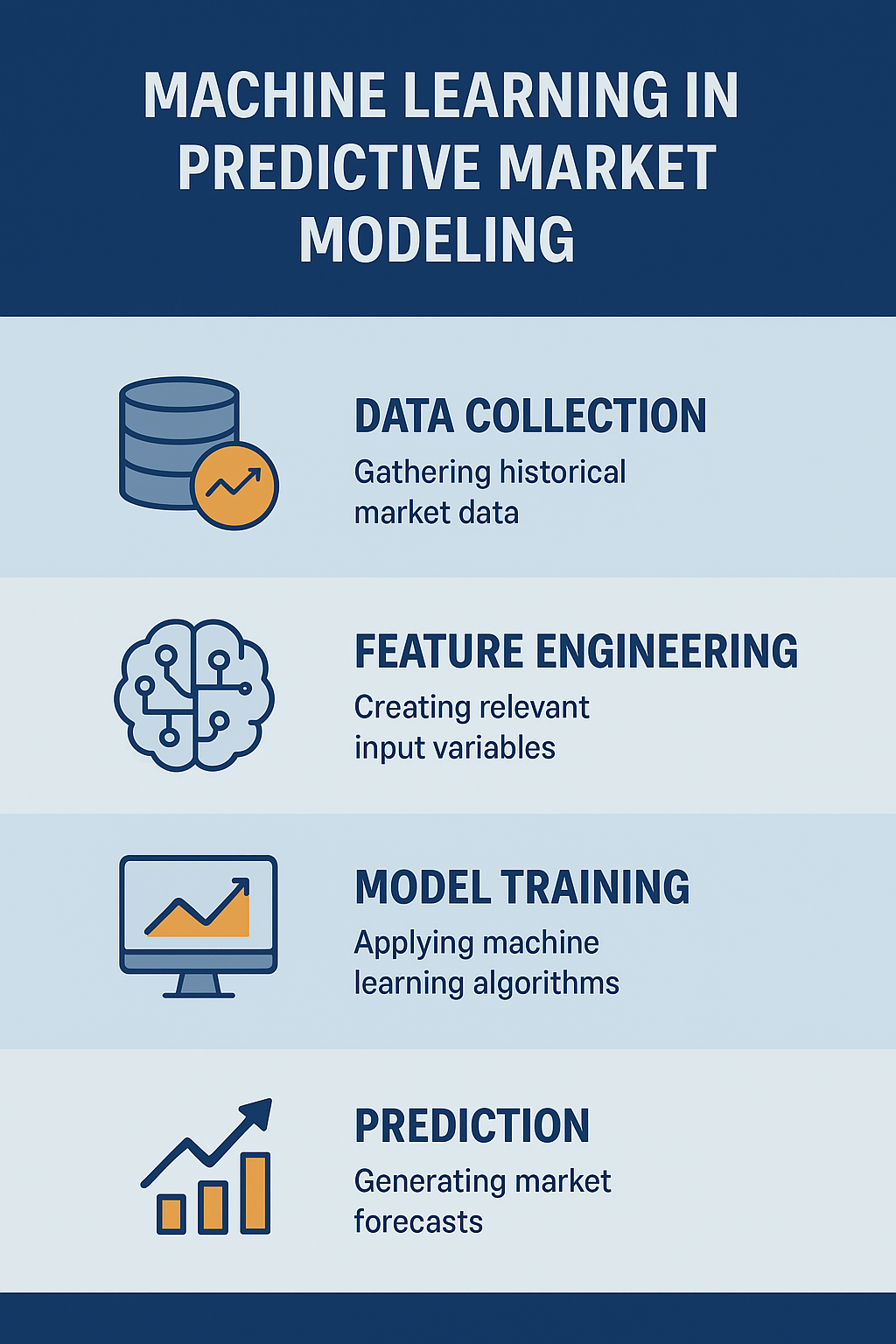
Stop using lagging indicators. Our definitive guide reveals how to build ML-driven forecasting models with LSTMs & XGBoost. Master alternative data, avoid fatal overfitting, and learn the lifecycle of a robust trading algorithm. Unlock predictive power.
The New Era of Financial Forecasting
For decades, financial market prediction was dominated by traditional econometric models—linear regressions, GARCH models, and ARIMA time series. These approaches, while foundational, often struggled to capture the complex, non-linear, and chaotic nature of global markets. The advent of machine learning represents a paradigm shift, moving us from simplistic assumptions to data-adaptive, algorithmic intelligence. This in-depth exploration is designed for quants, data scientists, and sophisticated investors seeking to understand how ML algorithms are not just supplementing but fundamentally revolutionizing predictive market modeling. We will delve beyond the hype, examining the specific techniques, data sources, and practical challenges of deploying statistical learning in the relentless pursuit of alpha.
Section 1: The Fundamental Shift: From Econometrics to Algorithmic Intelligence
1.1 The Limitations of Linearity in a Non-Linear World
Traditional models rely on predefined relationships and stationary data. However, financial markets are dynamic ecosystems influenced by feedback loops, regime changes, and human behavioral biases that break these assumptions. Machine learning excels precisely where these models fail, by learning complex patterns directly from the data without rigid structural constraints.
1.2 Core Machine Learning Paradigms in Finance
Understanding the taxonomy of ML is crucial for selecting the right tool for the task.
- Supervised Learning: The most common approach for prediction. The model is trained on labeled historical data (e.g., features like past prices and volumes) to predict a target variable (e.g., future price direction or volatility).
- Unsupervised Learning: Used for discovering hidden structures. Techniques like clustering can identify distinct market regimes (e.g., “high-volatility, risk-off” vs. “low-volatility, bull”) or group correlated assets for portfolio construction.
- Reinforcement Learning (RL): An emerging frontier where an agent learns optimal trading strategies through trial and error, maximizing a reward function (e.g., Sharpe ratio) while interacting with the market environment.
Section 2: The Algorithmic Toolkit: Key ML Models for Market Prediction
2.1 Tree-Based Models: Power and Interpretability
- Random Forests: An ensemble method that builds a “forest” of decision trees. Each tree is trained on a random subset of the data and features, and their predictions are averaged. This “bagging” technique reduces overfitting and makes Random Forests robust and highly effective for ranking feature importance.
- Gradient Boosting Machines (XGBoost, LightGBM): These are currently the workhorses of many quantitative hedge funds. Unlike Random Forests, boosting builds trees sequentially, with each new tree correcting the errors of the previous one. This often leads to superior predictive accuracy, though it requires careful tuning to avoid overfitting.
2.2 Support Vector Machines (SVM) for Classification
SVMs are powerful for classification tasks, such as predicting the direction of a stock’s movement (up/down). They work by finding the optimal hyperplane that best separates different classes in a high-dimensional space. They are particularly effective in complex but small-to-medium sized datasets.
2.3 The Deep Learning Revolution: Modeling Temporal Dependencies
- Recurrent Neural Networks (RNNs): Designed for sequential data. Their internal memory allows them to persist information, making them theoretically ideal for time series.
- Long Short-Term Memory (LSTM) Networks: A specialized RNN architecture that solves the “vanishing gradient” problem, enabling them to learn long-range dependencies in data. This makes them exceptionally powerful for forecasting financial time series by capturing complex, multi-day patterns and momentum effects.
- Convolutional Neural Networks (CNNs): While famous for image recognition, 1D CNNs can be applied to time series to automatically detect local patterns and salient features across different time scales, much like identifying edges in an image.
2.4 Unsupervised Techniques: Finding the Hidden Signal
- K-Means Clustering: Can be used to identify groups of assets that behave similarly, aiding in diversification and portfolio construction. It can also segment different market environments based on volatility and correlation structures.
- Principal Component Analysis (PCA): A dimensionality reduction technique used to decompose asset returns into uncorrelated factors (principal components). This is invaluable for risk modeling, arbitrage strategies, and simplifying complex datasets without losing critical information.
Section 3: The Fuel of Intelligence: Data Sources and Feature Engineering
3.1 Beyond Price and Volume: The Alternative Data Universe
The edge in modern predictive modeling often comes from novel data sources.
- Sentiment Analysis: Using Natural Language Processing (NLP) on news articles, social media feeds (e.g., Twitter), and corporate filings to gauge market mood.
- Satellite and Geospatial Data: Tracking car counts in retail parking lots, oil tanker shipments, or agricultural land health.
- Transactions and Flow Data: Analyzing credit card transactions or the order flow from institutional brokers.
3.2 The Art and Science of Feature Engineering
Raw data is rarely useful. Feature engineering is the process of creating informative input variables for the models.
- Technical Indicators: Transforming raw price data into established indicators like RSI, MACD, and Bollinger Bands.
- Rolling Statistics: Calculating time-windowed features like rolling volatility, z-scores, and correlations.
- Domain-Informed Features: Creating features based on economic theory or market microstructure (e.g., bid-ask spread dynamics, order book imbalance).
Section 4: The Model Lifecycle: From Training to Deployment
4.1 The Critical Step: Robust Backtesting
A model that looks good in theory must be proven in simulation. Backtesting involves running the model on historical data to see how its signals would have performed. Key considerations include:
- Avoiding Look-Ahead Bias: Ensuring no future information is leaked into the training process.
- Splitting Data Correctly: Using a time-series split (e.g., Walk-Forward Analysis) instead of a random split to preserve the temporal order of data.
- Accounting for Transaction Costs: A strategy is only profitable if it can overcome the costs of trading (slippage, commissions).
4.2 The Peril of Overfitting: When the Model Learns the Noise
Overfitting is the cardinal sin of ML. It occurs when a model becomes too complex and learns the random noise in the training data instead of the underlying signal. An overfitted model will look brilliant in backtests but fail catastrophically in live markets. Techniques to combat this include:
- Regularization (L1/L2): Penalizing model complexity during training.
- Cross-Validation: Using out-of-sample data to tune hyperparameters.
- Simpler Models: Often, a well-tuned simpler model outperforms an overly complex one in live trading.
4.3 The Final Hurdle: Live Deployment and Monitoring
Deploying a model to a live trading environment is a monumental task. It requires a robust, low-latency infrastructure. Crucially, models must be continuously monitored for model decay—the natural erosion of predictive power as market dynamics evolve. This necessitates periodic retraining and a clear protocol for when to retire a model.
Section 5: Challenges and the Ethical Frontier
5.1 The “Black Box” Problem
Many powerful ML models, especially deep learning, are often seen as inscrutable “black boxes.” The lack of interpretability can be a significant barrier for risk managers and regulators. The field of Explainable AI (XAI), with techniques like SHAP and LIME, is emerging to shed light on model decisions.
5.2 Data Snooping and Multiple Hypothesis Testing
With vast computational power, it’s easy to test thousands of potential strategies on historical data. By pure chance, some will appear profitable. Rigorous statistical standards must be applied to avoid this data snooping bias.
5.3 Ethical Considerations and Systemic Risk
The proliferation of ML-driven algorithmic trading raises questions about market fairness, flash crashes, and the potential for herding behavior if many funds use similar signals, potentially amplifying systemic risk.
Conclusion: The Symbiotic Future of Man and Machine
Machine learning is not a magic bullet for market prediction. It is a powerful, sophisticated tool that amplifies the skills of the practitioner. The future of predictive modeling lies not in replacing the human quant, but in a symbiotic relationship where human intuition, domain expertise, and ethical oversight guide the immense pattern-recognition capabilities of artificial intelligence. For those who master the intricate dance between robust data science, financial theory, and relentless risk management, ML offers an unparalleled edge in the endless quest to decode the markets.