
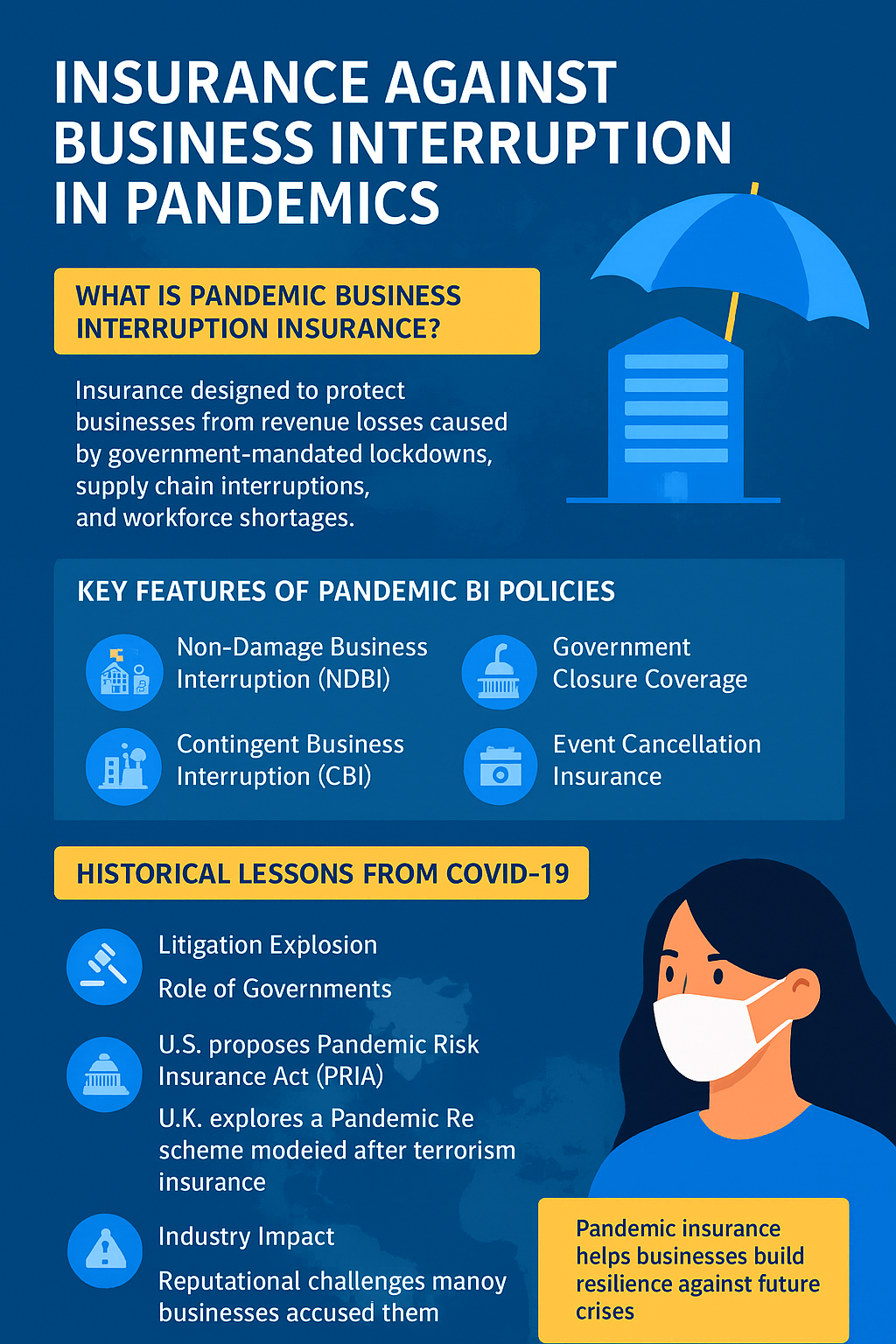
Learn how pandemic business interruption insurance protects companies from lockdowns, supply chain failures, and revenue loss during global health crises.
A Wake-Up Call for Businesses Worldwide
The COVID-19 pandemic exposed one of the greatest vulnerabilities of modern businesses—interruption of operations due to global health crises. From local restaurants and retail shops to multinational corporations, enterprises faced unprecedented losses as lockdowns, supply chain disruptions, and labor shortages brought the global economy to a halt.
Traditional business insurance was not designed to cover pandemics. This gap in protection led to widespread litigation, financial devastation, and a renewed urgency to rethink business interruption insurance tailored for pandemics.
This article explores the concept, history, challenges, and future of pandemic-related business interruption insurance, offering insights into how companies can prepare for the next crisis.
1. Understanding Business Interruption Insurance
1.1 What Is Business Interruption Insurance?
Business interruption (BI) insurance provides compensation for lost income and operating expenses when a company is forced to suspend operations due to external factors. Typical triggers include:
- Fire and natural disasters.
- Equipment breakdowns.
- Property damage that halts production.
1.2 The Gap During Pandemics
The problem lies in the fact that standard BI insurance requires physical property damage to trigger payouts. Pandemics, however, cause disruption without damaging physical assets, leaving most businesses uninsured.
2. Pandemic Business Interruption Insurance: Concept and Need
2.1 What Is Pandemic-Specific BI Insurance?
Pandemic BI insurance is a specialized coverage designed to protect businesses from revenue losses caused by:
- Government-mandated lockdowns.
- Supply chain interruptions.
- Workforce shortages due to illness.
- Event cancellations.
2.2 Why It Matters
Without such coverage, companies risk insolvency. According to estimates, global business losses during COVID-19 exceeded $4 trillion, much of it uninsured.
3. Key Features of Pandemic BI Policies
- Non-Damage Business Interruption (NDBI): Coverage that applies even without physical property damage.
- Government Closure Coverage: Reimburses businesses forced to shut down due to official orders.
- Contingent Business Interruption (CBI): Protects against supply chain failures caused by pandemics.
- Event Cancellation Insurance: Covers lost revenue from canceled conferences, concerts, or sporting events.
- Parametric Triggers: Payments linked to defined pandemic events (e.g., WHO pandemic declaration).
4. Historical Lessons from COVID-19
4.1 Litigation Explosion
Thousands of lawsuits were filed against insurers who denied claims, arguing that pandemic losses were not covered.
4.2 Role of Governments
Some governments considered public-private partnerships to share pandemic risks. For instance:
- The U.S. proposed the Pandemic Risk Insurance Act (PRIA).
- The U.K. explored a Pandemic Re scheme, modeled after terrorism insurance programs.
4.3 Industry Impact
Insurance companies faced reputational challenges, as many businesses accused them of abandoning policyholders during their greatest time of need.
5. Challenges in Insuring Pandemics
5.1 Unpredictability of Scale
Unlike localized disasters, pandemics are global, simultaneous, and prolonged, making them extremely costly.
5.2 Moral Hazard
Widespread payouts may encourage businesses to take fewer precautions.
5.3 High Premiums
Insurers must charge higher premiums to cover systemic risks, limiting affordability for small businesses.
5.4 Reinsurance Capacity
Even global reinsurers face difficulties absorbing pandemic-level losses.
6. Innovations in Pandemic BI Insurance
6.1 Parametric Insurance
Instead of requiring proof of loss, policies pay out automatically based on triggers such as infection rates or government shutdown orders.
6.2 Public-Private Partnerships
Governments working with insurers to create risk pools ensures broader protection and lower premiums.
6.3 Technology and Data Analytics
Big data, AI, and epidemiological modeling help insurers forecast infection spread and financial impact, improving risk assessment.
6.4 Sector-Specific Products
- Hospitality Coverage: Hotels and restaurants with tailored pandemic protection.
- Entertainment Coverage: Concerts, festivals, and sporting events insured against shutdowns.
- Manufacturing Coverage: Factories protected from workforce and supply disruptions.
7. Case Studies: Pandemic BI Insurance in Action
7.1 Wimbledon’s Pandemic Policy
The All England Club had a pandemic insurance policy for years before COVID-19, which paid out nearly $141 million after the 2020 cancellation.
7.2 Hollywood Production Insurance
Film studios faced shutdowns but benefited from pandemic-related riders covering cast illness and production delays.
7.3 Small Business Adaptation
Some boutique insurers in Asia developed parametric BI policies for small retailers, providing faster payouts than traditional models.
8. Global Perspectives on Pandemic BI Insurance
8.1 North America
Debates over PRIA highlight the U.S. struggle to balance insurer liability and business needs.
8.2 Europe
EU regulators encourage insurers to integrate pandemic coverage into resilience frameworks.
8.3 Asia-Pacific
China and Japan lead innovation in epidemic risk modeling and micro-insurance products for SMEs.
8.4 Africa and Emerging Markets
Pandemic BI insurance remains limited, but micro-insurance initiatives are expanding access.
9. Future of Business Interruption Insurance in Pandemics
- Integration of Digital Health Data: Real-time infection tracking to trigger coverage.
- Expansion of Global Risk Pools: International cooperation to distribute financial burdens.
- Broader Regulatory Mandates: Governments requiring pandemic coverage for certain industries.
- Rise of ESG Insurance Products: Linking pandemic resilience to corporate sustainability strategies.
10.FAQ Section
Q1: Does standard business interruption insurance cover pandemics?
No. Traditional BI insurance requires physical damage, which pandemics do not cause.
Q2: What is non-damage business interruption insurance?
It provides coverage for losses even when there is no property damage, such as during pandemics.
Q3: What industries benefit most from pandemic BI insurance?
Hospitality, retail, manufacturing, entertainment, and healthcare sectors gain the most protection.
Q4: How do parametric pandemic policies work?
They use predefined triggers like infection rates or government shutdowns to pay claims quickly.
Q5: Will pandemic BI insurance become mandatory in the future?
Possibly, as regulators push for more resilient business continuity frameworks.
Conclusion: Building Resilient Businesses in a Post-Pandemic World
The COVID-19 crisis proved that pandemics are not “once-in-a-century” anomalies but recurring risks. Pandemic business interruption insurance is no longer optional—it is an essential tool for survival in the global economy.
By combining private-sector innovation with public-sector support, insurers can design sustainable products that protect businesses while maintaining market stability. The future belongs to companies that embrace resilience, and pandemic BI insurance will be a cornerstone of that resilience.
1 thought on “Best Insurance Against Business Interruption in Pandemics 2026”