
Navigating the Yield Curve in Your Personal Finances
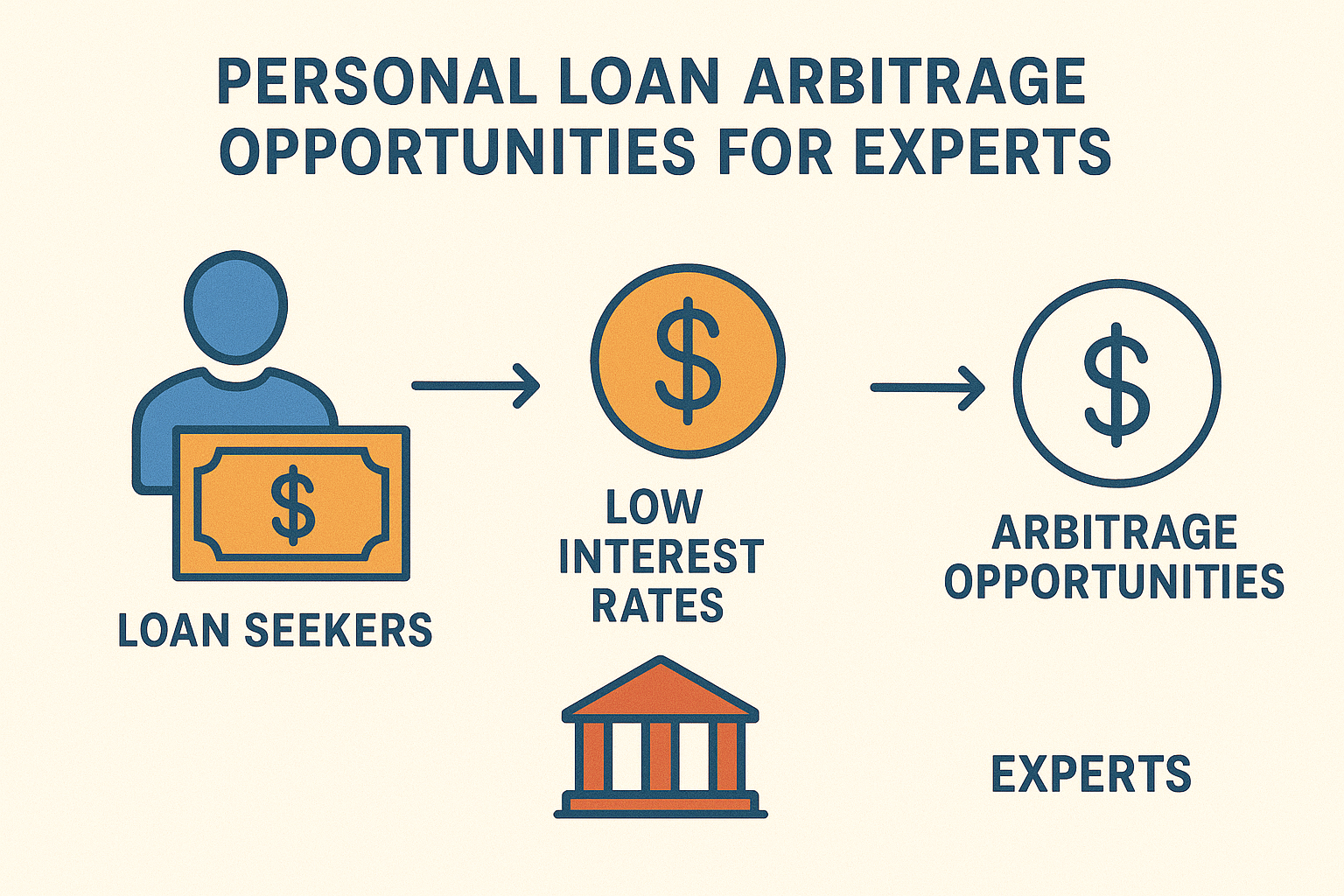
In the institutional world, arbitrage—the simultaneous buying and selling of assets to profit from price discrepancies—is a cornerstone of quantitative finance. But what if this concept could be scaled down and applied to personal finance? Enter the controversial and high-stakes realm of personal loan arbitrage: the strategy of borrowing money at a low interest rate with the explicit intention of investing it in a higher-yielding asset.
For the average individual, this is a perilous path. For the financially sophisticated—those with a deep understanding of risk metrics, tax implications, and market volatility—it represents a potential avenue for leveraging cheap debt to amplify returns. This is not a guide for the faint of heart or the financially illiterate. It is a masterclass for experts who comprehend that what appears to be “free money” is, in reality, a complex trade with defined risks that must be meticulously managed.
This article will deconstruct the theoretical framework, model the precise mathematics, illuminate the profound risks, and outline the execution blueprint for those considering this advanced financial maneuver. We will move beyond the simplistic blog post advice and into the granular details that separate a successful carry trade from a catastrophic financial blunder.
Chapter 1: The Foundational Principle – Identifying the Opportunity
At its core, personal loan arbitrage is a classic carry trade. The goal is to capture the positive spread, or “carry,” between your cost of debt and your return on investment.
1.1 The Essential Arithmetic
The fundamental equation is simple:
Net Profit = (Investment Return - Cost of Debt) * Capital
However, the devil is in the details. The calculation must be net of all fees, taxes, and inflation. The critical metric is the After-Tax Risk-Adjusted Spread.
- Example: You secure a personal loan of $50,000 at a 7% APR. You invest the full amount in a corporate bond portfolio yielding 9%.
- Gross Spread = 9% – 7% = 2%.
- But this is not your profit. You must account for:
- Loan Origination Fees: A 2% fee effectively increases your cost of capital.
- Taxes: Interest income is typically taxed as ordinary income, while the loan interest may be deductible only if the funds are used for a specific investment (consult a tax professional; this is a complex area).
- Investment Fees: Management fees for funds or trading commissions.
1.2 Sourcing Favorable Credit
The feasibility of this strategy hinges on accessing low-cost, unsecured debt. Experts might exploit:
- Promotional Balance Transfer Offers: Credit cards offering 0% APR for 12-18 months with a 3% balance transfer fee.
- Relationship Banking Rates: High-net-worth individuals often receive preferential loan rates from private banks.
- Credit Union Advantages: Member-owned institutions sometimes offer below-market personal loan rates.
Chapter 2: The Investment Universe – Deploying the Capital
Where can one reliably find a return that exceeds the cost of personal debt? The answer is: nowhere with certainty. However, experts target specific asset classes.
2.1 Fixed-Income Instruments
The most straightforward pairing. The logic is to lend money at a higher rate than you are borrowing it.
- Investment-Grade Corporate Bonds: Seeking bonds with a yield-to-maturity that clears the after-tax hurdle rate.
- Peer-to-Peer (P2P) Lending Notes: Building a diversified portfolio of loans on platforms that can yield 8-12%, accepting the corresponding default risk.
- High-Yield Savings Accounts & CDs: This is a low-risk, low-reward scenario. It is only feasible if one can secure a personal loan at a rate lower than the risk-free rate, which is exceptionally rare and usually a temporary market inefficiency.
2.2 Equity Market Strategies
This introduces significant volatility risk. A 20% market crash can obliterate the positive carry.
- Dividend Aristocrats: Investing in companies with a long history of stable and growing dividends. The goal is for the dividend yield plus modest capital appreciation to exceed the loan cost.
- Covered Call Writing (The Wheel Strategy): Using the borrowed capital to buy shares of stock and then selling call options against them to generate premium income. This can enhance yield but caps upside potential.
2.3 Alternative and Illiquid Assets
For the highly specialized, this can include:
- Private Credit Funds: Which often target returns in the low-to-mid teens but require capital to be locked up for years.
- Hard Money Lending: Acting as a lender for real estate flips, though this requires expertise and carries high default risk.
Chapter 3: The Quantified Risk Framework – Modeling the Downside
This is the chapter that separates experts from amateurs. The strategy is not about the potential gain, but about the management of potential loss.
3.1 Risk #1: The Volatility Mismatch
A personal loan is a fixed liability with a mandatory repayment schedule. Your investment, especially in equities, is a volatile asset. If the market tanks, you still owe the monthly payment. This is a classic liquidity and solvency risk. Experts stress-test their portfolio against a 2008-style drawdown.
3.2 Risk #2: The Spread Inversion
Your investment returns are not guaranteed. The yield on your bond portfolio can fall, or the company can cut its dividend. Meanwhile, your cost of debt is often fixed. If your investment return drops below your borrowing cost, you have a negative carry and are losing money each month.
3.3 Risk #3: The Black Swan Event
A job loss combined with a market downturn creates a scenario where you are forced to sell assets at a loss to cover loan payments. This is the terminal risk of the strategy.
3.4 The Margin of Safety Calculation
Experts employ a conservative hurdle rate. They do not simply seek a 1-2% spread. They might require a projected 5-6% spread to compensate for the risks undertaken. They also model scenarios where they must service the debt for 6-12 months from their cash reserves if the investment income dries up.
Chapter 4: The Execution Playbook – From Theory to Practice
A disciplined, systematic approach is non-negotiable.
Step 1: Capital Preservation and Structuring
- Never invest the entire loan proceeds. Set aside 6-12 months of loan payments in a high-liquidity cash account as a buffer.
- Consider the loan term. A 5-year loan provides more time for investments to recover from a downturn than a 2-year loan.
Step 2: Diversification is Paramount
- Do not invest the entire $50,000 in a single stock or bond. Spread it across at least 20-30 different securities or use low-cost, diversified ETFs to mitigate idiosyncratic risk.
Step 3: Automated Risk Management
- Set predetermined stop-losses or rebalancing bands. If the portfolio value falls by a certain percentage (e.g., 15%), a pre-defined de-risking protocol is triggered.
Chapter 5: The Ethical and Psychological Dimensions
5.1 The Lender’s Covenant
Most personal loan agreements explicitly prohibit the use of funds for investments. While enforcement is challenging, a breach could technically allow the lender to demand immediate full repayment (acceleration clause). This is a legal and ethical gray area.
5.2 The Psychological Toll
Carrying a significant, non-mortgage debt load to fund a volatile investment portfolio creates immense psychological pressure. It can lead to panic selling during downturns, the exact opposite of what a savvy investor should do. The “sleep-at-night” factor is a critical, unquantifiable variable.
Conclusion: A Strategy of Nuance, Not Certainty
Personal loan arbitrage is not a wealth-building secret; it is a leveraged bet on the stability of positive spreads. For every success story, there are untold stories of significant losses. It magnifies both gains and losses.
For the true expert, it is a tool—one of many in a sophisticated financial toolkit. It requires a robust personal balance sheet (significant other assets, stable high income), a cast-iron stomach for risk, and the analytical rigor of a hedge fund manager. For everyone else, the risks overwhelmingly outweigh the potential rewards. In the pursuit of alpha, the most prudent arbitrage opportunity may often be the one you decline.